


Natural Resources Canada
www.nrcan.gc.ca
Common menu bar links
Office of Energy Efficiency Links
Office of Energy Efficiency
Menu
Improving Energy Performance in Canada – Report to Parliament Under the Energy Efficiency Act For the Fiscal Year 2006-2007
PDF Version | Table of Contents | Next Page
Chapter 5: Industry
ENERGY USE AND GREENHOUSE GAS EMISSIONS
The industrial sector includes all manufacturing industries, all mining activities, forestry and construction. However, it excludes electricity generation. This sector uses energy in industrial processes as a source of motive power and to produce heat or to generate steam. Overall, industrial energy demand accounts for 37.9 percent (3209 petajoules [PJ]) of secondary energy use and 33.1 percent (164 megatonnes [Mt]) of greenhouse gas (GHG) emissions (including electricity-related emissions).
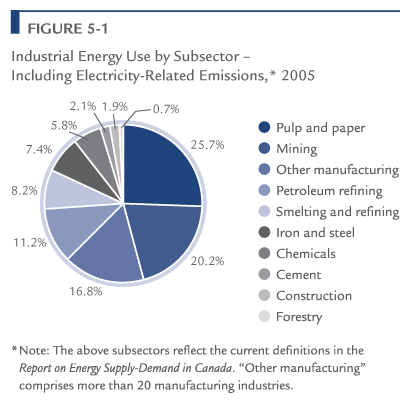
In the industrial sector, energy is consumed primarily in pulp and paper production, mining, petroleum refining, and in the smelting and refining industries. Pulp and paper production alone accounted for approximately 25.7 percent of total industrial energy demand in 2005 (see Figure 5-1).
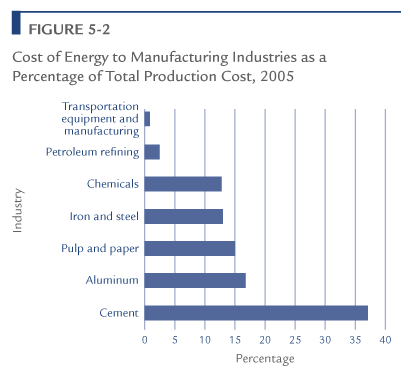
In most industries, energy purchases account for only a small portion of total expenditures. However, for some relatively energy-intensive industries – cement, aluminum, pulp and paper, iron and steel, and chemicals – this share is higher than 12 percent (see Figure 5-2). For cement, in particular, the share is as high as 37.1 percent.
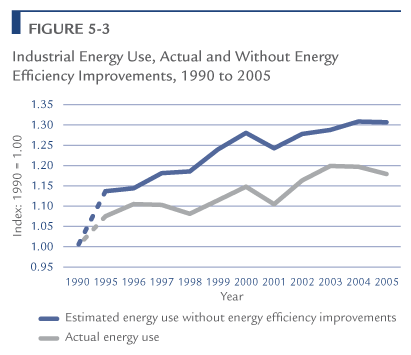
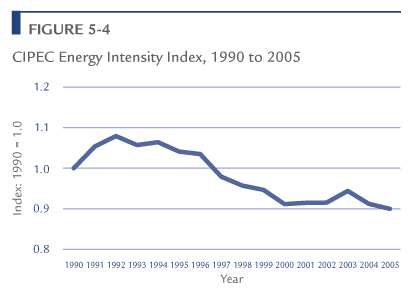
Actual industrial energy use increased by 17.9 percent (488 PJ) between 1990 and 2005. This increase was caused by a 43.9 percent increase in industrial activity, measured as a combination of physical units of production, gross output and gross domestic product (GDP). However, some of the increase in energy use that would have resulted from the increase in activity was offset by improvements in energy efficiency and structural change (the shift to less energy-intensive industries such as electrical and electronics).
Three main factors influenced energy use:
- activity – Increases in the physical units of production, gross output and GDP contributed to a 43.9 percent increase in industrial activity resulting in a 1166-PJ increase in energy use.
- structure – The change in the mix of activity toward less energy-intensive industries caused a 331-PJ decrease in energy use.
- energy efficiency – Due to a 12.8 percent improvement in energy efficiency, the industrial sector avoided 347 PJ of energy use between 1990 and 2005.
The change in energy use between 1990 and 2005 and the estimated energy savings due to energy efficiency are shown in Figure 5-3.
Between 1990 and 2005, industrial GHG emissions, including electricity-related emissions, increased by 15.5 percent. Excluding electricity-related emissions, industrial GHG emissions increased by 8.0 percent. Most of this increase in direct GHG emissions occurred in the upstream oil and gas industry, because the mining (excluding upstream), manufacturing and construction industries realized an 8.7 percent decrease in GHG emissions.
Natural Resources Canada (NRCan) delivers initiatives to increase energy efficiency in the following components of the industrial sector:
- industrial processes and technologies
- equipment (see Chapter 2)
- buildings (see Chapter 4)
INDUSTRIAL PROCESSES AND TECHNOLOGIES:
Industrial Energy Efficiency – Canadian Industry Program for Energy Conservation
Objective: To help Canadian industry use energy efficiency investments to improve productivity and competitiveness and to contribute to Canada’s clean air and climate change goals.
The Canadian Industry Program for Energy Conservation (CIPEC) is a unique industry-government partnership committed to promoting and encouraging energy efficiency improvements and reductions in GHG emissions through voluntary action across Canada’s industrial sectors, including the mining, manufacturing, forestry, construction, upstream oil and gas, and electricity generation sectors.
CIPEC’s network comprises 28 sector leadership networks (including four regional) that share information and best practices; more than 1000 industrial companies that have made a written voluntary commitment to become more energy efficient and support Canada’s climate change initiatives; and partnerships with 52 industry associations that disseminate information and advice on energy efficiency to their members.
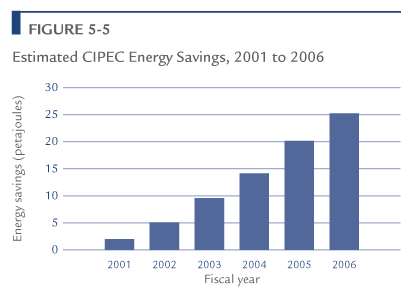
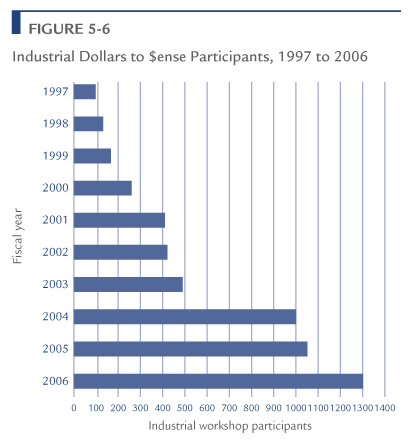
CIPEC’s multifaceted approach focuses on introducing technological innovations, bringing about behavioural change, and shifting organizational culture to generate a sustainable market transformation. Tools and services offered through CIPEC included energy fora and conferences; communications products including Web sites and newsletters, technical guidebooks, energy benchmarking and best practices studies; Dollars to $ense energy management workshops; cost-shared energy audits and Process Integration (PI) studies; and provision of technical information relating to the eligibility of renewable energy and/or energy efficiency systems for accelerated capital cost allowances under Class 43.1 and Class 43.2 of the Income Tax Act. CIPEC achieved GHG reductions of 0.36 Mt in fiscal year 2006–2007.
Key 2006-2007 Achievements
- Conducted energy audits at 137 industrial facilities.
- Trained 1303 industrial energy managers in Dollars to $ense workshops.
- Sent the Heads Up CIPEC newsletter to 1500 new industrial clients.
INDUSTRIAL PROCESSES AND TECHNOLOGIES:
Industrial System Optimization Program
Objective: To support the development and adoption of innovative energy-efficient design practices in Canadian industry to improve energy efficiency and productivity while reducing GHG emissions and other environmental impacts.
The Industrial System Optimization Program focuses on techniques to analyse plant-wide industrial processes, such as PI and advanced process control systems. The Program analyses these processes to identify and correct inefficiencies in plant operation and design, while also considering energy, economy and environmental factors.
The Program tries to meet its objective by conducting leveraged research and development.(R&D) through national and international cooperation. Furthermore, the Program disseminates technical information to encourage adoption of these techniques and practices in targeted energy-intensive sectors of Canadian industry. Those sectors include pulp and paper, oil upgrading and refining, petrochemicals, steel, chemicals, food and drink, and solid wood.
Key 2006-2007 Achievements
- Successfully completed a pilot PI program to promote and implement sound PI practices in 31 plants in both regulated and non-regulated sectors. NRCan offers support to help industrial companies conduct PI studies to identify opportunities for increasing energy efficiency and improving production processes. By using energy more efficiently, industry can become more competitive and help reduce GHGs and air pollution. It is estimated that annual energy-cost savings of approximately $1 billion and economic spin-offs of approximately $6 billion are achievable over a 5-year period. The PI program also represents a major opportunity to change the way energy analysis is conducted in the industry, thereby improving productivity and competitiveness of this sector.
- Developed a systematic approach to assess potential upgrading of distillation systems in the chemical industry. A clear methodology was developed, Thermodynamically Guided Modelling, for top-level analysis of the energy, purity and productivity tradeoffs in separation processes and for structural optimization of retrofit separation installations. For example, the conceptual retrofit design of a C2 splitter of the NOVA Chemical ethylene site was completed. The potential savings in the heat supply can reach up to 47 percent. The savings in the heat supply correspond to electrical power savings of 5.6 megawatts in the refrigeration system that serves the C2 splitter. These results will be key assets for future studies on petrochemicals.
- Developed a multi-objective optimization methodology for industrial production systems. This methodology simultaneously integrates the adaptability of an algorithm, advanced constraint handling, system decomposition, a combined local optimality search and global optimality determination. The algorithm gives a choice of solutions that represents the best trade between the targeted objective functions.
For more information:
cetc-varennes.nrcan.gc.ca/en/indus.html
INDUSTRIAL PROCESSES AND TECHNOLOGIES:
Industry Energy Research and Development Program
Objective: To encourage and support the development and application of leading-edge, energy-efficient and environmentally responsible processes, products, systems and equipment in industry.
The Industry Energy Research and Development (IERD) program gives financial support for commercially confidential applied R&D activities. If the project is a commercial success, the clients must repay the funds. Program clients from all industrial sectors range from small and medium-sized companies to multinational corporations.
Key 2006-2007 Achievements
- DDI-Heat Exchangers Inc. of Dollard-des-Ormeaux, Quebec successfully demonstrated that its CubeTM heat exchanger technology can recover heat from liquids (sludge) containing a high percentage (65 percent) of suspended solids in an application where conventional heat exchanger designs have failed. This demonstration helped DDI sell its heat exchanger technology to a bio-solids processing plant in the United States (U.S.). Considering the untapped market for heat recovery from sewage sludge and other high viscosity liquids in industry, it is projected energy savings will be 11 PJ and projected carbon dioxide (CO2) reduction from the heat exchanger technology in Canada will be 0.545 Mt over the next 10 years.
- The Puratone Corporation of Niverville, Manitoba, developed an energy management system for hog producers. This award-winning system is called "BarnMax." The technology is expected to help hog producers reduce energy consumption by an average of 86 megajoules for each pig produced. Energy savings from BarnMax technology in Canada over the next 10 years is projected to be 15 PJ. Over the same period, the technology is expected to reduce CO2 emissions by 0.726 Mt.
- The IERD program supported General Comminution Inc. (GCI) of Toronto, Ontario in a full-scale field trial. The trial proved the technical feasibility of the GCI Szego mill to reactivate spent sorbent for a fluidized bed combustion boiler. Using reactivated limestone will reduce CO2 emissions from limestone calcination and will also reduce the landfill requirements for solid wastes. Successful implementation will result in reduced landfill requirements for spent sorbent and a reduction in GHG emissions by 14 850 t annually initially in Canada, growing to 162 000 t in North America with the potential to reach 1 305 000 t globally by 2011. Total energy savings in Canada from implementation of the development is 222 750 gigajoules (GJ) annually.
- Financial support was provided in conjunction with the BC Hydro Power Smart Progam for a field trial of a newly developed pulp screen rotor by the University of British Columbia. Other supporters of the project were Canadian Forest Products and Advanced Fiber Technologies. The new rotor used 52 percent less electrical energy than the conventional equipment it replaced. The potential energy savings if all 300 pulp mills in British Columbia were converted are 153 200 megawatt hours of electricity annually.
- A project with Hamilton Steel G.P. Inc. was completed with results of a reduction of 104 500 t of CO2 annually and an annual energy reduction of 260 000 GJ for their No. 5 Blast Furnace project in Hamilton, Ontario. The project was one of several initiated almost eight years ago by Union Gas Limited of Chatham, Ontario with IERD and Technology Early Action Measures. The objective was to convert key heavy industry production processes from high-carbon fuel (oil or coal) to lowercarbon natural gas using advanced, innovative technologies. The funding partners were Hamilton Steel, NRCan, Union Gas Limited and Air Liquide Canada Inc. Based on an advanced computational fluid dynamic modelling by the CANMET Energy Technology Centre in Ottawa, Ontario, the approach taken was to optimize the co-injection of pulverized coal and natural gas in the blast furnace. This process enabled the displacement of a greater percentage of the coke requirement and resulted in reductions in overall CO2 emissions from the site as well as other benefits such as cost reduction and productivity improvement.
- With IERD support, Agile Systems Inc. successfully completed an R&D program for integrated electronic motor controls. The potential energy savings by 2012 are 2013 terajoules and GHG emission reductions of 109 105 t.
For more information:
nrcan.gc.ca/es/etb/cetc/cetc01/htmldocs/Publications/ierdpublications/fact
sheet_industry_energy_r&d_e.htm
INDUSTRIAL PROCESSES AND TECHNOLOGIES:
Clean Electric Power Generation
Objective: To design, develop and deploy technologies for power generation from fossil fuels with increased efficiency and the reduction, and ultimately elimination, of emissions of acid rain precursors, GHGs, particulates and identified priority substances – mercury, trace elements and organic compounds.
Research focuses on improving the performance of and reducing emissions from existing fossil fuel power plants and on developing new advanced cycles for conversion of fossil fuels to electricity with complete or nearly complete capture and elimination of CO2 and other emissions. Issues covered by other research projects include the transport and storage of CO2.
NRCan’s work also includes changing the interaction of the combustion system within the process through advanced tools and technologies to assist major industrial energy consumers to reduce the energy intensity of their operations and to reduce GHG emissions and emissions of other air pollutants, while enhancing competitiveness and profitability.
Key 2006-2007 Achievements
- Completed a technology feasibility study that identifies the ThermoEnergy Integrated Power System Process, a new generation power cycle, as having technical and economic advantages over existing clean coal technologies currently identified in both Canada and the U.S.
- Developed a combustion methodology to burn emulsified bitumen and water mixtures cleanly in conventional boilers in place of more expensive fuels. This technology will be used to support the economic viability of Canadian industries in the resource recovery sectors and to ensure a reliable and inexpensive supply of electricity from Canadian utilities.
- Assembled an International Flaring Consortium comprised of seven private sector and special interest organization members to establish best practices for industrial flares to minimize climate change effects and the health impacts of all industrial flares and to improve air quality.
For more information:
nrcan.gc.ca/es/etb/cetc/cetc01/htmldocs/Groups/clean_
electric_power_generation_e.htm
INDUSTRIAL PROCESSES AND TECHNOLOGIES:
Processing and Environmental Catalysis Program
Objective: To solve industrial process problems and undertake research in areas with high potential for significant environmental and economic benefits.
The program’s facilities, including semi-pilot-scale plants, are used for process testing and the evaluation of novel concepts in chemical and energy conversion, including hydrogen production from hydrocarbon and renewable sources. Clients include oil and gas companies, petrochemical companies, engine manufacturers, waste oil recyclers and renderers, and specialty ceramic manufacturers.
Key 2006-2006 Achievements
- Developed technology for desulphurizing diesel fuel that is produced by thermally cracking waste lubricating oil. A bench-scale continuous processing unit was commissioned for testing the CANDES process. The project has support from the waste oil recycling industry.
- Determined the preferred operating conditions to transform bitumen residue from oil sands upgrading to an additive suitable for making high quality concrete.
- Developed a direct ammonia fuel cell with unique catalytic surfaces for efficient combined heat and power applications. Bench-scale fuel cell development is being undertaken by three federal laboratories. A field trial using ammonia and the catalytic fuel cell surface in a conventional 5-kilowatt fuel cell control system is being arranged in partnership with a fuel cell and ammonia company.
For more information:
www.nrcan.gc.ca/es/etb/cetc/cetc01/htmldocs/Groups/industrial_
innovation_e.htm
INDUSTRIAL PROCESSES AND TECHNOLOGIES:
Mine Ventilation
Objective: To reduce energy consumption and GHG emissions associated with mine ventilation through infrastructure automation (to support demand-based delivery systems), ventilation network optimization and management and less air-volume-demanding technology.
Ventilation is required in underground mines to maintain a safe working environment. It is used to dilute and remove harmful pollutants (dusts and gases) and to provide suitable working climates. However, providing adequate ventilation can account for 40 percent of the energy consumed during mineral extraction in underground mines. Ventilation systems naturally include some over-supply capacities in order to accommodate all potentially available production locations. This over-supply is highly dependent on the individual mine, the mineral deposit and the mining method employed.
Metal mines that were traditionally designed to operate at maximum delivery – i.e. peak demand across all potential production locations 24 hours a day, 7 days a week – are now starting to adjust ventilation systems to match actual production needs. Energy savings can be significant and include potential reductions in the use of the auxiliary and main ventilation infrastructure, as well as savings in the energy used in air cooling or heating processes.
Optimizing energy use and reducing GHG emissions and costs is not a straightforward proposition because it depends on the specific consumption profile (i.e. electricity versus heating fuels and primary versus secondary delivery systems), design criteria and geographic location of each mine and therefore requires evaluation on a case-by-case basis.
Key 2006-2007 Achievements
- To assess potential cost savings, energy requirements and GHG reduction strategies, CANMET Mining and Mineral Sciences Laboratories worked on a process-based modelling approach for determining ventilation needs. Historical production data from a large northern Ontario mine was used to analyze diesel equipment deployment to estimate the energy savings that could have resulted from adjustments in the ventilation regimes, based on activity. Results show that depending on the level of automated control, energy cost savings of the order of 50 percent or higher could have been realized at that mine.
- The concept of ventilation on demand continues to be investigated through collaborative work with Hydro-Québec and the Quebec mining industry. The impact of automation of ventilation systems will be investigated in representative mine operations and will be extrapolated to all Quebec mines.
For more information:
nrcan.gc.ca/mms/canmet-mtb/mmsl-lmsm/mines/air/air-e.htm
INDUSTRIAL PROCESSES AND TECHNOLOGIES:
Enhanced Recycling for Minerals and Metals
Objective: To reduce GHG emissions from Canada’s minerals and metals sector by enhancing mineral and metal recycling processes and practices.
The Enhanced Recycling Program for Minerals and Metals aims to increase Canada’s potential to recycle mineral and metal materials by developing new approaches and improving on existing recycling infrastructure, practices and policies. In August 2006, the Program received $505,000 for the implementation of selected projects that held high potential for GHG emission reductions.
The Enhanced Recycling Advisory Committee expanded to include a broader range of experts. The 2006–2007 implementation plan identified three main initiatives: scrap metal from municipal sources; end-of-life roofing materials; and federal government waste electronic and electrical equipment.
Key 2006-2007 Achievements
- An estimated 40 000 t (52 000 t of CO2 equivalent [CO2e]) of municipal stockpiled scrap metal was identified for recycling in northern communities of British Columbia, Alberta, Saskatchewan, Manitoba and the territories. The Ottawa Valley Waste Recovery Centre in the Township of Laurentian Valley, Ontario, expanded its residential curbside collection of metal recyclables, resulting in a tripling of revenues from $50/t to $195/t. A Nova Scotia pilot project proposed to add empty paint and aerosol cans to municipal curbside collection programs, resulting in savings of 5460 t of CO2e annually.
- A workshop with experts from across Canada and the U.S. took place in Toronto, in February 2007, to evaluate options for environmentally sound recycling of roofing materials. It was estimated that 1.25 million t of asphalt-based roofing materials are discarded annually in Canada. If 5 percent of this discarded material is substituted for virgin asphalt, this would produce an annual savings of 90 000 t of CO2e. Two key applications for recycled asphalt are for road surfaces and energy recovery.
- NRCan, in consultation with key stakeholders, is developing a Federal Government Waste Electronic and Electrical Equipment Strategy that will ensure environmentally sound recovery and recycling of end-of-life information technology equipment arising from government use (65 000 computers per year, or 1000 t of CO2e).
For more information:
recycle.nrcan.gc.ca
INDUSTRIAL PROCESSES AND TECHNOLOGIES:
Supplementary Cementing Materials Program
Objective: To reduce annual GHG emissions by promoting increased use of supplementary cementing materials (SCMs) in concrete as partial replacement of cement.
The Supplementary Cementing Materials (SCM) Program has the objective of increasing awareness of the benefits of SCMs, both in terms of GHG reduction potential and the performance of concrete. In August 2006, the Program received $235,000 specifically to conduct the following two activities:
- disseminating of information dealing with the use of SCMs in concrete and holding consultative meetings, in order to increase acceptance from stakeholders and to better understand stakeholders’ positions and concerns
- assessing improvement in SCM use by conducting a qualitative assessment survey and evaluating the change in SCM use during the last three to five years
Key 2006-2007 Achievements
- Disseminated SCM information through the development and distribution of a brief, yet informative, SCM Basics document and a series of consultative meetings with key industry and government stakeholders. Feedback was obtained at 18 consultative meetings, held in 9 cities, with approximately 80 people in attendance.
- Conducted an online survey for a qualitative assessment. The survey response (173 completed) was statistically significant and satisfactory, considering the small number of people who could respond to the specialized topic.
- Interviewed stakeholders across Canada. The information collected confirmed the increased use of SCMs during the last three to five years:
- Manitoba Infrastructure and Transportation is increasing the amount of fly ash in its specification from 0 percent to 15 percent.
- The City of Winnipeg, Manitoba, is experimenting with a change to 25 percent fly ash in city roads and sidewalks.
- Inland Cement is introducing a sulphate-resistant blended cement incorporating approximately 30 percent fly ash.
- The average content of fly ash in concrete in Nova Scotia in 2002 was from 17 percent to 19 percent, as opposed to 6 percent in the rest of Atlantic Canada.
For more information:
scm.gc.ca
