


Natural Resources Canada
www.nrcan.gc.ca
Common menu bar links
Office of Energy Efficiency Links
Office of Energy Efficiency
Menu
Improving Energy Performance in Canada – Report to Parliament Under the Energy Efficiency Act For the Fiscal Year 2006-2007
PDF Version | Table of Contents | Next Page
Chapter 4: Buildings
ENERGY USE AND GREENHOUSE GAS EMISSIONS
The commercial/institutional sector includes activity related to trade, finance, real estate, public administration, education and commercial services, including tourism. This sector uses energy mainly for space and water heating, space cooling, lighting, motive power for services such as pumping and ventilation in buildings, and street lighting.
In 2005, the commercial/institutional sector accounted for 13.6 percent (1153 petajoules [PJ]) of secondary energy use and 13.2 percent (65.3 megatonnes [Mt]) of greenhouse gas (GHG) emissions.
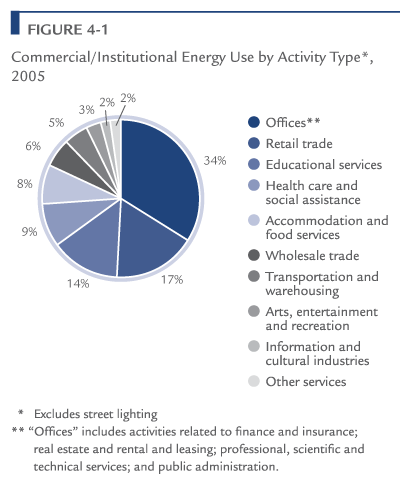
To highlight energy use in commercial/institutional activities, the following analysis excludes energy use for street lighting. The commercial/institutional sector comprises many activity types (see Figure 4-1). Offices account for 35 percent of the sector’s energy demand. Retail trade, educational services, health care and social assistance, and accommodation and food services account for another 47 percent of that demand. Natural Resources Canada’s (NRCan’s) initiatives address all these major energy-using activity types.
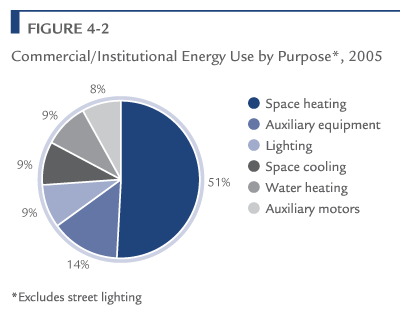
Energy is used for six purposes in commercial/institutional activities. The largest of these is space heating, which accounts for more than half of energy use in this sector (see Figure 4-2). Each of the remaining five uses of energy accounts for between 8 and 14 percent of energy demand in this sector.
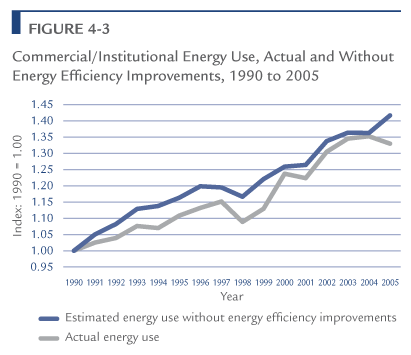
Between 1990 and 2005, the commercial/institutional energy use increased by 33 percent, or 286 PJ (from 867 to 1153 PJ).
However, GHG emissions from the sector rose by 36.7 percent in the same period. Emissions increased more quickly than energy use because of the increased use of energy sources with a higher GHG content.
During 1990–2005, a steady increase in activity largely contributed to increased energy use. To a lesser degree, the service level, which refers to the increase of auxiliary equipment and the space cooling penetration rate, and the weather affected energy use. The impact of structural changes (the mix of building types) was marginal. However, energy efficiency slowed this rate of increase. Specifically, the energy use changes attributed to each of these factors are:
- activity – A 28.1 percent increase in floor space caused a 247-PJ increase in energy use. This year, the Office of Energy Efficiency (OEE) reviewed the historical floor space database.
- weather – The winter in 2005 was colder than in 1990, but the summer was warmer than in 1990. The net result was a 2.9 percent increase in energy use (25 PJ).
- structure – A shift in activity caused a 0.1 percent decrease in energy use (1 PJ).
- service level – An increase in the service level for end-users caused a 10.6 percent increase in energy use (92 PJ).
- energy efficiency – An 8.7 percent improvement in energy efficiency caused a decrease in energy use of 75 PJ.
The change in energy use between 1990 and 2005, as well as the estimated energy savings due to energy efficiency, are shown in Figure 4-3.
NRCan delivers initiatives to increase energy efficiency in the following subsectors of the commercial/institutional sector:
- new buildings
- existing buildings
- equipment (see also Chapter 2.)
- communities
NEW BUILDINGS:
Commercial Building Incentive Program
Objective: To improve the energy efficiency of new commercial, institutional and multiunit residential buildings.
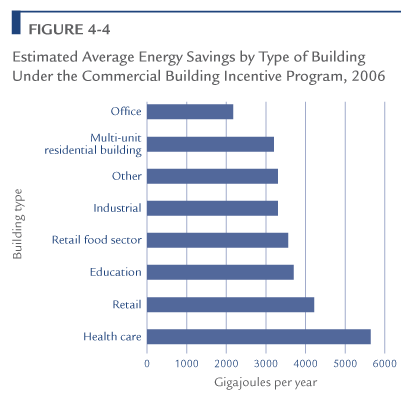
The Commercial Building Incentive Program (CBIP) provided financial incentives to builders and developers who incorporated energy-efficient features into the design and construction of new commercial, institutional and multiunit residential buildings.
To qualify for the incentive, buildings had to be at least 25 percent more energy efficient than similar buildings constructed to the Model National Energy Code of Canada for Buildings (MNECB). However, results indicate that CBIP buildings are on average 36 percent more energy efficient than similar buildings constructed to the MNECB.
The program was delivered by the Government of Canada and co-marketed by provincial/territorial utilities, provincial/territorial energy efficiency and climate change agencies, and building professional organizations. CBIP achieved 0.07 Mt of GHG reductions in fiscal year 2006–2007.
Key 2006-2007 Achievements
- The program validated that more than 250 projects met the CBIP criteria and gave incentives to 229 projects, which represent 5 percent of building starts and 17 percent of construction floor space.
- The registered users of NRCan's building design energy simulation/compliance software increased by more than 1000 to 6500.
- The Canadian Commission on Building and Fire Codes approved a business plan submitted by the NRCan-supported Buildings Energy Codes Collaborative to update the MNECB.
For more information:
oee.nrcan.gc.ca/newbuildings
NEW BUILDINGS:
Industrial Building Incentive Program
Objective: To improve the energy efficiency of new industrial buildings.
The Industrial Building Incentive Program (IBIP), a demonstration program, extended the precepts of CBIP to the industrial sector. IBIP offered an incentive to companies that built new energy-efficient industrial facilities. The incentive offset the additional costs involved in initial attempts to produce energy efficient designs and achieve building and process integration. The design was assessed against a reference generated from the MNECB. The program resulted in GHG reductions of 0.001 Mt in fiscal year 2006–2007.
Key 2006-2007 Achievements
- Supported two IBIP projects that showed building and process integration. The program supported 28 projects (including these two) since the launch of the program in 2002.
- Produced a case study on refrigerated warehouses.
- Completed five recipient audits of the demonstration projects.
For more information:
oee.nrcan.gc.ca/newbuildings
EXISTING BUILDINGS:
EnerGuide for Existing Buildings or the Existing Buildings Initiative
Objective: To encourage commercial businesses and public institutions to become more energy efficient and reduce GHG emissions.
The EnerGuide for Existing Buildings (EEB) program helps commercial organizations and public institutions explore energy efficiency options and strategies. The program provides access to tools and financial assistance to help reduce energy costs and improve competitiveness.
Members join EEB by sending a letter to the Minister of Natural Resources from senior management that states their commitment to energy efficiency. The program has more than 2800 commercial, institutional and multiunit residential organizations as members. GHG reductions in the 2006–2007 fiscal year under EEB were 0.1.Mt.
Key 2006-2007 Achievements
- The EEB program signed 143 contribution agreements for retrofit projects (see Table 4-1) and 61 contribution agreements for planning activities.
- Projects that received financial incentives under EEB are expected to result in averaged energy savings of approximately 20 percent.
- Over 250 organizations registered with the program.
For more information:
oee.nrcan.gc.ca/existingbuildings
TABLE 4-1
| Fiscal year | Retrofit projects signed | Estimated energy cost savings (millions of dollars) |
Eligible client investment (millions of dollars) | Federal incentive (millions of dollars) |
|---|---|---|---|---|
| 1998 | 12 | 5.67 | 57.29 | 2.56 |
| 1999 | 35 | 16.78 | 143.17 | 5.38 |
| 2000 | 4 | 5.44 | 9.29 | 0.62 |
| 2001 | 30 | 10.57 | 58.03 | 3.66 |
| 2002 | 58 | 19.06 | 147.53 | 7.89 |
| 2003 | 66 | 16.09 | 140.88 | 8.37 |
| 2004 | 168 | 34.88 | 237.93 | 16.52 |
| 2005 | 129 | 23.36 | 133.62 | 11.29 |
| 2006 | 143 | 21.71 | 156.80 | 10.40 |
| Total | 645 | 153.56 | 1084.54 | 66.69 |
NEW AND EXISTING BUILDINGS:
Refrigeration Action Program for Buildings
Objective: To reduce GHG emissions by reducing energy consumption and synthetic refrigerant use in Canadian supermarkets and ice and curling rinks.
The program activities include information, capacity building, demonstrations, partnerships, and incentives. NRCan delivers the program in partnerships with provincial governments and utilities, associations, manufacturers, and consulting firms.
(See Chapter 2: Equipment, Standards and Labelling.)
Supermarkets provide a window of opportunity for innovative refrigeration systems because new construction and major renovation projects are expected in the coming years. Every three years, approximately 10 percent of the supermarkets undergo major renovation work. Also, approximately 100 large supermarkets are built every year.
There are 2501 ice rinks and 1037 curling rinks in Canada that are used by local communities and contribute to the social well being of many Canadians. Most of these buildings are 25 years old and an estimated 30 to 40 percent of the rinks are operating beyond their projected lifespan.
During the next decade, major renovations of ice rinks will exceed 2000 units, with an additional 1000 units for curling rinks. The potential impacts for these applications have been evaluated at 4.0 Mt carbon dioxide equivalent per year. The energy use savings are in the range of 25 to 50 percent.
Key 2006-2007 Achievements
- RETScreen® Refrigeration software for ice and curling rinks was launched.
- CoolSolution*, an efficient refrigeration application to reduce energy use and contribute to reducing GHG emissions, was implemented to qualify ice and curling rink installations.
- An incentive program was put in place for Canadian ice and curling rinks. Incentives were given for 21 feasibility studies and 25 installations.
- NRCan participated in a Canadian Standards Association committee to update the code for commercial refrigeration, in particular considering the use of carbon dioxide (CO2).
- NRCan signed an agreement with Loblaw Properties Limited to demonstrate, for the first time in Canada, the use of CO2 for commercial refrigeration.
For more information:
cetc-varennes.nrcan.gc.ca/en/b_b/parb_rapb.html
NEW AND EXISTING BUILDINGS:
Intelligent Buildings
Objective: To develop and promote the adoption of intelligent building technologies and innovative building operation practices that reduce energy consumption and GHG emissions.
The program focuses on intelligent building technologies and practices, such as recommissioning, that reduce a building’s energy consumption while ensuring the occupants’ comfort and preserving indoor air quality. To meet its objectives, the program develops, demonstrates and deploys, in partnership with key stakeholders, intelligent buildings technologies in Canadian commercial/institutional buildings.
Key 2006-2007 Achievements
- Continued demonstration projects across Canada aimed at evaluating and improving the Continuous Building Optimization approach and the Diagnostic Agent for Building Operators (DABO) software.
- Delivered advanced retrocommissioning training at CETC-Varennes, in collaboration with Portland Energy Conservation Inc., to enhance the practical knowledge of its demonstration projects partners.
- Improved the DABO software by incorporating performance indices. DABO is the software tool developed at CETC-Varennes to support the process of optimizing building operation and ensure persistence of the energy efficiency measure implemented.
For more information:
cetc-varennes.nrcan.gc.ca/en/b_b/bi_ib.html
BUILDINGS AND COMMUNITIES:
Energy Science and Technology in Buildings and Communities
Objective: To reduce energy use, resource consumption and emissions from commercial buildings through design, construction and retrofitting while increasing cost-effectiveness. To optimize the interactions between buildings, the energy systems involved within them, and their communities. To develop and demonstrate practical decision-making tools and best practices that allow communities to undertake effective energy planning initiatives.
The CANMET Energy Technology Centre (CETC) works in partnership with associations, government and industry. They develop and deploy specialized solutions to achieve cost-effective reductions in the energy consumption and GHG emissions of buildings and communities.
CETC experts in energy innovations for the built environment take a leadership role, nationally and internationally, in the research, development, and deployment of energy-efficient and renewable energy technologies for new and retrofit buildings and communities.
Design and analysis tools remain key elements for accelerating innovation in new construction, retrofit and major renovation projects in large buildings. These tools are essential components of integrated design approaches that allow the implementation of energy efficiency at minimal incremental costs. There is still a lack of uptake for these tools, leading to capacity shortages in the marketplace.
Tools also enable advancement of technologies by allowing a project to simulate ideas rather than run expensive trials at the early high-risk stages and help the integration of emerging technologies by using advanced design and modelling. Building envelope work in hybrid systems (e.g. building integrated photovoltaics) continues to offer almost untapped (at least by market penetration numbers) opportunities for advancement.
Services such as lighting, daylighting and intelligent building control are key innovation areas, and system recommissioning in existing buildings offers opportunities for energy savings with little physical change. Finally, integration of a diversified energy supply, from fuel cells to renewable energy technologies, represents a significant gap between the current status and the desired status to meet long-term energy goals.
A key barrier that prevents change in standard development practices is the lack of tools and information that relate development style to energy and environmental impact.
Innovation in the following areas can create change:
- tools (computational or others) that consider energy consumption and emissions from the community from a systems perspective
- processes that guide the creation of community strategies for energy efficiency and the reduction of GHGs
- methods that help decision-makers differentiate between urban development alternatives based on their environmental impact on the community
- community energy standards that support policies, codes and technical standards for energy-efficient development practices
Key 2006-2007 Achievements
- The Code Commission agreed to update the MNECB for 2012. CETC founded the Building Energy Code Collaborative with provincial, territorial and NRCan representation. The Collaborative submitted a business plan to the Code Commission for the update.
- A combined heat and emergency power system was installed at Villa Colombo, a long-term care facility in Vaughn, Ontario, to replace the oil-fired emergency power plant. This 335-kilowatt natural gas unit provides both heat and emergency power. A critical component of this project was a revision to the CSA 282 code that previously did not allow the use of natural gas in emergency power systems. This change removes a large barrier to adoption of combined heat and power (CHP) systems and reduces the cost of a CHP system by 20 percent because a separate emergency system is not needed.
- CETC developed a Community Energy Planning Guide. The guide helps communities understand and evaluate land use, infrastructure, energy systems, building and site design and waste management decisions in the context of a sustainable energy future. To date, communities have requested 700 guides.
- CETC assessed the feasibility and monitored the progress of the Iqaluit District Energy System project on behalf of the Opportunities Envelope Secretariat. The Iqaluit District Energy System collects waste heat from the diesel-electric power plant in Iqaluit and provides it to a new hospital built adjacent. The system was commissioned in January 2007.
- Construction began for the installation of a 1-megawatt expansion turbine at the letdown station of a gas utility in Toronto, Ontario. This concept replaces the conventional pressurereducing valve with an expansion turbine, which reduces pressure and, at the same time, uses this pressure reduction to produce electricity by turning a turbine wheel at very high speeds.
For more information: sbc.nrcan.gc.ca
* CoolSolution is an official mark of Her Majesty the Queen in Right of Canada as represented by the Minister of Natural Resources.
