


Natural Resources Canada
www.nrcan.gc.ca
Common menu bar links
Office of Energy Efficiency Links
Office of Energy Efficiency
Menu
Improving Energy Performance in Canada – Report to Parliament Under the Energy Efficiency Act For the Fiscal Year 2006-2007
PDF Version | Table of Contents | Next Page
Chapter 3: Housing
ENERGY USE AND GREENHOUSE GAS EMISSIONS
The residential sector includes four major types of dwellings: single detached, single attached, apartments and mobile homes. Energy is used in dwellings for space heating and cooling, heating water, and for operating appliances, electronic equipment and lights. This sector accounts for 16.5 percent (1402 petajoules [PJ]) of secondary energy use and 14.9 percent (74 megatonnes [Mt]) of greenhouse gas (GHG) emissions.
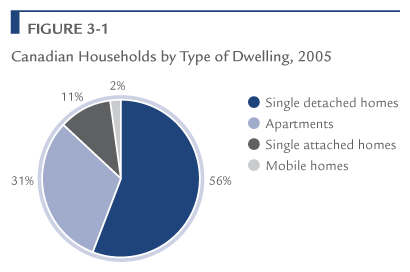
Most dwellings in Canada are single detached houses. The next largest number of dwellings is apartments, followed by single attached dwellings and mobile homes (see Figure 3-1). Because single detached and attached houses predominate, most Natural Resources Canada (NRCan) residential building programs focus on these types of dwellings.
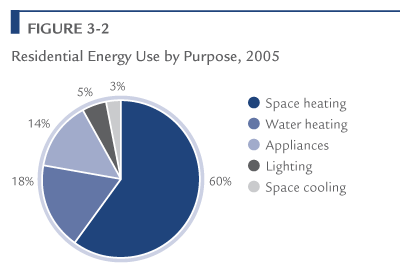
Space and water heating constitute 78.0 percent of residential energy use, followed by the shares devoted to operating appliances, lighting and space cooling (see Figure 3-2).
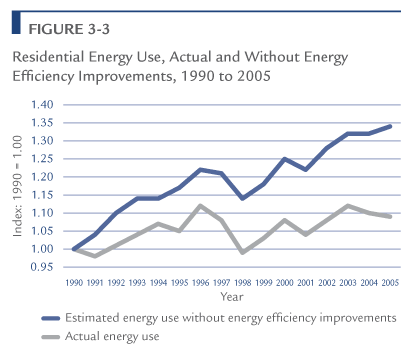
Between 1990 and 2005, residential energy use increased by 9.0 percent, or 116 PJ (from 1286 to 1402 PJ). For the same period, GHG emissions from the residential sector increased by 6.3 percent. GHG intensity changed little because fuel switching toward less GHG-intensive fuels offset an increase in the GHG intensity of electricity production over the period.
Five main factors influenced residential energy use-activity, weather, structure, service level and energy efficiency:
- activity – The increase in the number of households and the size of dwellings (the principal measures of residential activity) increased energy use by 27.5 percent (353 PJ).
- weather – The winter in 2005 was similar to the winter in 1990 but summer temperatures were much warmer and the result was a 0.4 percent (6 PJ) increase in energy use in 2005 compared with 1990.
- structure – The relative share of households by dwelling type (single detached, apartments, etc.) has changed over the period. This change contributed to an increase in energy use of 0.6 percent (7 PJ) in 2005 compared with 1990.
- service level – The increased penetration rate of appliances and increased floor space cooled by space cooling units increased energy use by 5.5 percent (71 PJ).
- energy efficiency – Improvements in energy efficiency decreased energy use by 24.9 percent (321 PJ).
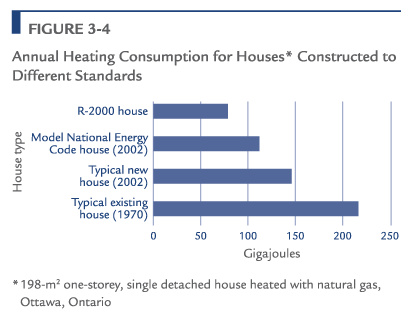
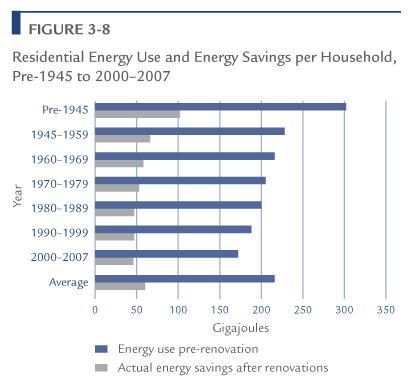
The change in residential energy use between 1990 and 2005 and the estimated energy savings due to 2005 and the estimated energy savings due to energy efficiency are shown in Figure 3-3. Figure 3-4 shows how energy consumption differs for houses built in different period, which reflects improvements in building construction.
Growth in residential energy use was driven in large part by growth in activity. This growth in activity, which is, more specifically, growth in total floor space and number of households, was due to the increase in the average size of newly constructed houses, the rising population and the trend toward fewer individuals per household (see Figure 3-5). Such increases were partially offset by significant improvements in energy efficiency. Structural changes also contributed to growth in energy use as more individuals tended to live in single detached homes and the relative share of individuals living in apartments declined. Similarly, service level increased energy demand because in 2005 more Canadians cooled their homes during the summer months and operated more appliances than they did in 1990.
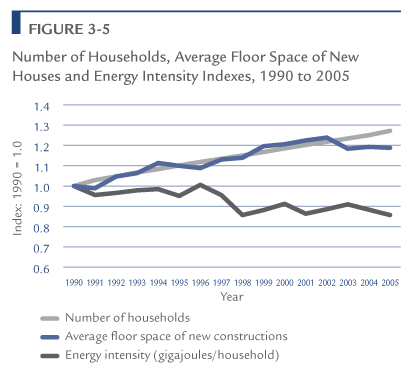
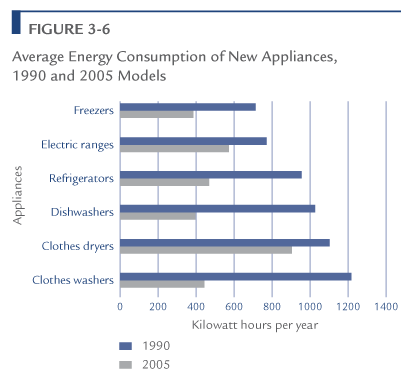
Figure 3-6 shows how average energy consumption of new appliances has improved by comparing 1990 and 2005 models.
NRCan delivers initiatives to increase energy efficiency in the following residential subsectors:
- new houses
- existing houses
- residential equipment (see Chapter 2)
NEW HOUSES:
R-2000 Standard and EnerGuide for (New) Houses
Objective: To increase market adoption of energy-efficient new houses by promoting changes in construction practices and by labelling houses for energy performance.
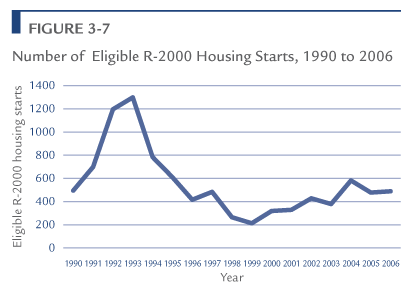
The R-2000 Standard is a voluntary technical performance standard. It encourages Canadian builders to build, and Canadian consumers to purchase, houses that are more energy efficient and environmentally responsible than is required by current Canadian building codes. NRCan trains and licenses R-2000 homebuilders and other professionals in R-2000 Standard construction techniques and practices, and provides third-party quality assurance by testing and certifying R-2000 homes.
EnerGuide for (New) Houses is an energy-performance rating and labelling scheme designed to encourage the industry to build, and consumers to purchase, houses that are more energy efficient. The EnerGuide for Houses scheme is based on the R-2000 Standard and training, and it targets large-volume, mass-market builders. GHG reductions for fiscal year 2006-2007 were 0.089 Mt.
Key 2006-2007 Achievements
- Supported 169 workshops nationally and trained 2433 people in energy-efficient construction systems for the new housing sector.
- Supported the Heating, Refrigeration and Air-Conditioning Institute and made available 38 courses about the design and installation of heating, ventilating and air-conditioning (HVAC) systems for 557 individuals.
- Achieved 10 percent penetration in the new housing market in Ontario (responsible for 45 percent of the new housing starts in Canada), largely as a result of efforts with tract builders.
- Collaborated with provinces to incorporate energy efficiency requirements within building codes. British Columbia, New Brunswick, Nova Scotia, Ontario and Quebec announced moves to achieve an energy rating level of 80 points by 2012. Eighty is the minimum rating for an R-2000 house.
For more information:
oee.nrcan.gc.ca/r-2000/english
EXISTING HOUSES:
EnerGuide For Houses and Retrofit Incentives
Objective: To encourage Canadians to improve the energy efficiency of their homes.
EnerGuide for Houses gave Canadian homeowners personalized advice about how to best improve the energy performance of their houses, especially for renovation and maintenance projects. Under EnerGuide for Houses, a retrofit incentive was officially launched in October 2003. Under this incentive, homeowners qualified for a non-taxable grant representing 10 to 20 percent of their retrofit expenditures. The grant was based on the differential improvement in the house's energy rating, as measured by a pre- and post-renovation EnerGuide for Houses energy evaluation. The program was terminated in 2006, but received $45 million in funding to be used for wind down activities.
Key 2006-2007 Achievements
- Processed more than 105 000 grants under the retrofit incentive.
- Achieved cumulative GHG reductions of 0.9 Mt as of March 31, 2006.
- Signed six Memorandums of Agreement with provinces and municipalities to ensure a smooth transition to provincial and municipal programs.
NEW AND EXISTING HOUSES:
Energy Science and Technology in Housing
Objective: To accelerate the development and market adoption of energy-efficient housing technologies in domestic and foreign markets through improved design, performance and cost-effectiveness and to develop practical decision-making tools to help communities and developers choose efficient energy systems and low-polluting waste and water technologies.
Working in partnership with associations, government and industry, the CANMET Energy Technology Centre (CETC) develops and deploys highly specialized solutions to help achieve cost-effective reductions in the energy consumption and GHG emissions of residential housing. CETC experts in energy innovations for the built environment take a leadership role, nationally an internationally, in the research, development, and deployment of leading-edge energy-efficient and renewable energy technologies for new and retrofit housing.
Key focuses of CETC take into consideration the following:
- Design and analysis tools remain a key element for accelerating innovation in both the new housing and retrofit markets. The ability to model emerging technologies to ascertain potential impacts and identify other opportunities is essential. The advancement of the design tools must keep pace with evolving technologies.
- Guidelines for both new and retrofit housing projects remain a high priority to enable voluntary, incentive-driven and regulated improvement to the housing stock.
- Energy demand reduction continues to offer opportunities in housing for improved envelope technologies and more efficient HVAC technologies.
- Improved energy systems, including integrating cogeneration, fuel cell and renewable energy alternatives, are essential to meeting long-term energy use goals.
Key 2006-2007 Achievements
- The success of a zone heating and cooling product named Zone Comfort is a great example of how CETC supports technology innovation in the private sector. Zone Comfort addresses comfort, humidity, energy, and peak energy demand in the summer. Key technical aspects of this new product evolved from the participation of Ecologix Heating Technologies Inc. in the eKOCOMFORT®* initiative. This product demonstrates how CETC supports technology innovation in the private sector and effectively guides innovative technologies from concept to commercialization and reduces the time to market. In this case, time to market was 18 months. CETC created a complete commercialization team that included market research, a development plan, a sales plan, funding and technology support.
- A research project used a hybrid hydrogen generator and natural gas furnace to evaluate if combustion appliances such as a furnace or hot water tank can burn more cleanly without requiring a retrofit. CETC evaluated the risks and performance characteristics of the combustion appliances. The test fuels were hydrogen and natural gas mixtures whose composition ranged up to 25 percent hydrogen. Results showed that a mixture of natural gas and 10 percent hydrogen is viable. Future integration with wind turbines and excess off-peak power is under consideration.
- Super ETM* housing is a technology transfer initiative that has increased market penetration of energy-efficient housing technologies and building practices from Canada into international markets. Through Super E, CETC has helped. Canadian companies adapt their products and services to meet increasingly higher international demands for environmentally friendly and energy-efficient housing. The Super E consortium includes 39 Canadian housing exporters who partner with 48 overseas companies. As of March 2007, over 400 houses were completed or under construction in markets such as Japan, the United Kingdom, Ireland, China, Korea and Iceland. The benefits to Canada are estimated at more than $40 million since the beginning of the initiative. Super E has also influenced the energy efficiency standards of housing packages offered by Canadian Super E members to the Canadian marketplace. Super E is delivered by CETC in partnership with the Canadian Forestry Service and the Canada Mortgage and Housing Corporation.
- CETC develops and supports building simulation software for the Canadian housing industry. Using the HOT2000TM** software created by CETC, 275 000 houses have been simulated for improved energy efficiency. CETC also develops and validates improved methods for modelling conventional energy systems while integrating more sophisticated technologies such as co-generation and renewable energy systems. Through the International Energy Agency – Energy Conservation in Buildings and Community Systems Annex 42, CETC developed simulation models for residential scale co-generation systems and tested natural gas technologies (e.g. fuel cells, Stirling engines, internal combustion engines) to validate these models.
- A project with CETC and the City of London, Ontario and seven of its local builders was undertaken to provide the builders with a method to systematically evaluate new energy-efficient products, systems and techniques. Some builders sent three or four staff to technology sessions as part of this project and are now starting to use the technologies. As a result of this project, the London Home Builders Association is now sponsoring its own project technology sessions. The City of London is very pleased with the results, and is creating an implementation plan for the subsequent field trial phase.
For more information:
sbc.nrcan.gc.ca
* eKOCOMFORT is a registered trademark of Her Majesty the Queen in Right of Canada as represented by the Minister of Natural Resources.
** Super E is a registered trademark of Her Majesty the Queen in Right of Canada as represented by the Minister of Natural Resources.
*** HOT2000 is an official mark of Natural Resources Canada.
