


Natural Resources Canada
www.nrcan.gc.ca
Common menu bar links
Office of Energy Efficiency Links
Office of Energy Efficiency
Menu
Improving Energy Performance in Canada – Report to Parliament Under the Energy Efficiency Act For the Fiscal Year 2006-2007
PDF Version | Table of Contents | Next Page
Chapter 6: Transportation
ENERGY USE AND GREENHOUSE GAS EMISSIONS
The transportation sector consists of three subsectors: passenger, freight and off-road. Passenger and freight transportation accounted for 55.0 percent and 41.1 percent, respectively, of transpor-tation energy use, and off-road represented only 3.9 percent in 2005 (see Figure 6-1). Due to limitations in the available data and the small percentage it accounts for, the off-road subsector is not analysed in further detail.
The passenger subsector has three modes: road, rail and air. The freight subsector, as defined by Natural Resources Canada (NRCan), is composed of road, rail, air and marine modes. In these two subsectors, road transport uses the most energy, accounting for 78.1 percent of total trans-portation energy use in 2005. Of this amount, 57.4 percent was passenger energy use and 42.6 percent was freight energy use.
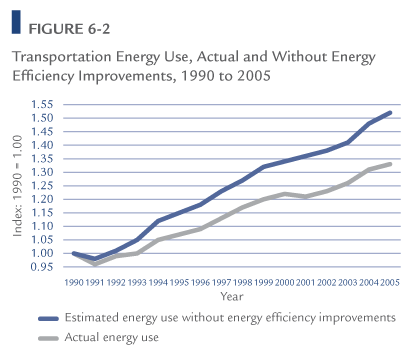
All transportation energy-use programs in NRCan focus on the energy used in road transportation. Total transportation energy use increased by 33.2 percent (624 petajoules [PJ]) between 1990 and 2005 (see Figure 6-2). Passenger transportation energy use increased by 15.9 percent (189 PJ), while freight transportation energy use increased by 61.5 percent (391 PJ).

Three main factors influenced energy use:
- activity – Increases in population and economic activity caused increased transportation activity (measured as passenger-kilometres for passenger transportation and tonne-kilometres for freight transportation). The change in activity increased transportation energy use by 40.0 percent (750 PJ). The freight and passenger segments contributed to this increase by 52.4 percent and 47.6 percent, respectively.
- structure – Shifts between modes of transport within both the freight and passenger segments caused an increase of 9.9 percent in transportation energy use (187 PJ). The effects of mode shifting were more pronounced in the freight segment because freight truck activity is growing faster than rail and marine activity.
- energy efficiency – Improvements in energy efficiency decreased energy use by 18.8 percent (352 PJ).
Without improvements in energy efficiency, increases attributable to activity and structure would have led to an increase in transportation energy use of 49.9 percent (937 PJ). However, actual energy use increased by only 33.2 percent. This change in energy use between 1990 and 2005, as well as the estimated energy savings due to energy efficiency, are shown in Figure 6-2.
The transportation sector accounts for 29.5 percent (2502 PJ) of secondary energy use and 35.9 percent (178 megatonnes [Mt]) of greenhouse gas (GHG) emissions. From 1990 to 2005, trans-portation energy use increased by 33.2 percent, and GHG emissions increased by 31.8 percent. The change in GHG intensity of transportation energy use was negligible.
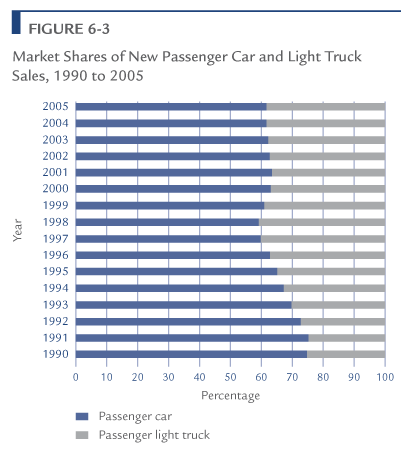
Figure 6-3 shows how the market share of new light trucks increased in the 1990s, reflecting the increase in popularity of minivans and sport-utility vehicles. Recently however, this trend seems to have stabilized with the share of light trucks remaining steady over the past few years. This higher share of heavier and more powerful passenger vehicles has had a significant effect on the increase in passenger energy use.
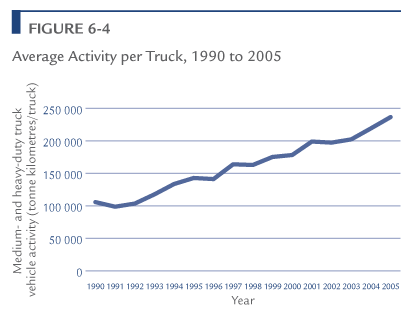
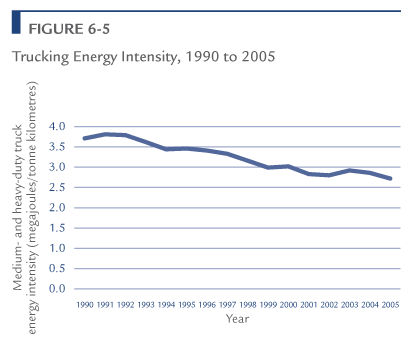
Figures 6-4 and 6-5 illustrate an improvement in trucking energy intensity despite an increase in average activity from 1990 to 2005. Improved fleet practices, caused by an increase in the competitiveness of the transportation sector and by the introduction of electronic engines, have improved fuel efficiency in medium- and heavy-duty trucks.
NRCan delivers initiatives in the following areas to increase the efficiency of motor vehicles and encourage the use of alternative fuels:
- vehicles
- transportation research and development
- alternative transportation fuels
- transportation technologies
VEHICLES:
Marketing of Efficient Vehicles
Objective: To improve motor vehicle fuel efficiency by encouraging private motorists to purchase energy-efficient vehicles and develop energy-efficient vehicle use and maintenance practices.
The Marketing of Efficient Vehicles program focuses on education and awareness campaigns that aim to improve fuel conservation behaviour with relation to vehicle selection, maintenance and use. Other objectives are to provide a coordinated approach to vehicle selection and use issues through the provision of information, tools and services to provinces, municipalities and community-level organizations. The program achieved GHG reductions of 0.01 Mt in fiscal year 2006-2007.
Key 2006-2007 Achievements
- Continued a carbon dioxide (CO2) rating system introduced in 2004. Since its inception, CO2 information has been distributed to over 1 million Canadians through on-line Web tools and the distribution of the annual fuel consumption guide. A vehicle ranking system is currently under development and in discussion with the vehicle manufacturers.
- Surveys confirmed that
- 60 percent of drivers believe that changing their driving habits and improving vehicle maintenance will result in reduced fuel costs
- 71 percent of Canadians considered fuel economy to be an important consideration in their next vehicle purchase
- 50 percent of Canadians would consider the vehicle's impact on the environment in their next vehicle purchase decision
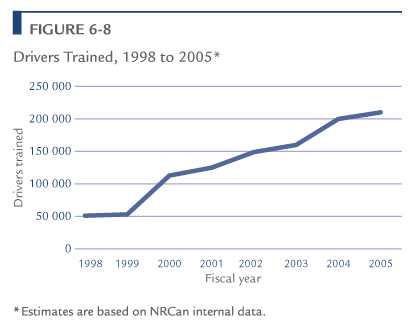
- One hundred and thirty thousand of the four hundred thousand new drivers taking driver education annually receive the Auto$mart Driver Education program.
- Thirty-three percent of driver instructors in Canada received driver training kits and/or training (the target is to ensure 50 percent of driver instructors are so educated).
VEHICLES:
Motor Vehicle Fuel Efficiency Initiative
Objective: To improve the fuel efficiency and reduce the GHG emissions of new light-duty vehicles sold in Canada.
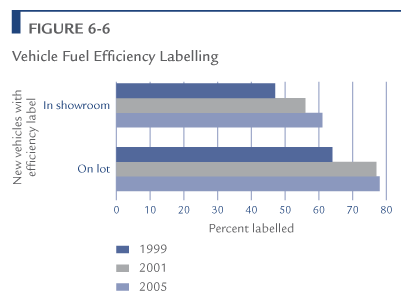
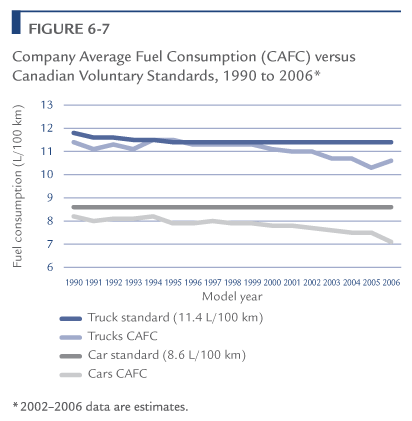
The goal of the Motor Vehicle Fuel Efficiency Initiative is to bring about a 25 percent improvement in the fuel efficiency of new light-duty vehicles sold in Canada by 2010. NRCan led negotiations with the automotive industry to a successful conclusion, reaching an agreement to reduce GHG emissions from this sector. The auto industry committed to a voluntary reduction in GHG emissions of 5.3 Mt annually from light-duty vehicle use by 2010. This 5.3-Mt target goes beyond fuel consumption reductions by incorporating reductions in all GHG emissions associated with vehicle use.
Key 2006-2007 Achievements
- The first progress report for the Motor Vehicle Fuel Efficiency Initiative was released in June 2006. It includes details about the Memorandum of Understanding (MOU), its approach and benefits, as well as the 5.3-Mt reduction goals. The report also outlined the mandate and terms of reference for the joint government-industry committee, which serves as the accountability mechanism to track progress and report on the MOU.
- Idle-free campaigns were conducted in communities that represent 32 percent of the Canadian population. Approximately 100 communities launched a campaign, and 90 percent will continue with their campaign in the 2007-2008 fiscal year. Several communities are implementing idling by-laws; 25 communities have already done so and 25 more are in the planning stages.
- Be Tire Smart campaigns were conducted with approximately 6 million Canadians. Surveys show that the number of people who properly inflate their tires by measuring the tire pressure at least once a month increased by 9 percent between 2003 and 2005. It is estimated that 50 percent of these people improved their tire inflation; this rate of change is expected to stay constant.
- While there was a modest increase of 2 percent in new light-duty vehicle sales in Canada in 2006, the sale of fuel-efficient subcompact vehicles increased by 19.8 percent.
For more information:
vehicles.gc.ca
VEHICLES:
Commercial Transportation Energy Efficiency and Fuels Initiative
Objective: To reduce the growth of GHGs from Canada's on-road commercial transportation fleets (passenger and commercial) through increased awareness and uptake of new technologies in energy efficiency, low GHG emissions technologies and alternative fuels.
Program delivery focuses on training initiatives such as SmartDriver and education activities to improve fuel conservation and increase awareness about the benefits of efficiency technologies. The Commercial Transportation Energy Efficiency and Fuels Initiative conducts studies and reports, and develops demonstration and technology transfer projects. GHG reductions for fiscal year 2006-2007 were 0.045 Mt.
Key 2006-2007 Achievements
- The demonstration of 3 "Star Trucks" affected the specification improvements of 66 trucks. The improvements are equal to removing 2000 t of GHG emissions from each truck annually.
- Long vehicle configuration was demonstrated along the Québec City-Windsor corridor.
- A Liquefied Natural Gas/Heavy-duty Pilot Ignition demonstration was completed.
VEHICLES:
Freight Efficiency and Technology Initiative
Objective: To reduce the growth of GHG emissions in the on-road freight transportation sector.
The Freight Efficiency and Technology Initiative aims to reduce the growth of GHGs through
- increased participation of the commercial transportation industry in voluntary climate change initiatives
- increased operating efficiency and environmental awareness among commercial transportation carriers and shippers
- increased adoption of existing and innovative environmental technologies and efficient best practices within the freight transportation sector
GHG emissions reductions for fiscal year 2006-2007 were 0.101 Mt.
Key 2006-2007 Achievements
- Conducted four Fuel Management 101 workshops with 55 participants. Thirty percent of participants implemented action plans that led to GHG reductions.
- Initiated an E-learning strategy to facilitate shippers' requirement for environmental carriers.
- Conducted the fifth annual Truck Stop Quiet Zone campaign. Seventy truck stops participated.
TRANSPORTATION RESEARCH AND DEVELOPMENT:
Canadian Lightweight Materials Research Initiative
Objective: To develop low-density, high-strength, lightweight materials to achieve weight reductions in ground transportation vehicles.
The Canadian Lightweight Materials Research Initiative (CLiMRI) is a research network comprising 29 companies, 8 universities and 7 government departments and funding agencies. CLiMRI's goal is to develop and implement lightweight, high-strength materials with transportation applications for the purpose of reducing GHG emissions where vehicle weight reduction results in improving vehicle efficiency and enhancing the competitiveness of Canadian primary metals producers, automotive part manufacturers and suppliers.
Key 2006-2007 Achievements
- Magnesium alloys are increasingly considered for automotive applications due to the potential for weight reduction, resultant fuel economy improvement and emissions reduction. Magnesium trials were completed to identify the effect of alloying additions, coatings, and sand systems on the fluidity of magnesium. The results indicated that it is possible to cast thin-walled sections for use in future automotive applications. Additionally, coatings were developed for sand casting processes to reduce cover gases used in this process and resulted in high-integrity castings. These achievements show significant potential for increasing the use of magnesium in the automotive industry.
- The demand for lightweight vehicles requires new advanced, high strength steel. The challenge for the steel industry is to develop ultra-high strength steels that have better ductility, to allow the formation of complex shapes. The properties of TRIP and DP steels, in particular, were developed incrementally. New ultra-high strength steels with ductility improvement through the Twinning Induced Plasticity effect show weight reduction and impact resistance. This is a major focus of the CANMET Materials Technology Laboratory (CANMET-MTL) research.
- Titanium components for automotive applications offer high strength, low density and resistance to corrosion. Conventional processing of titanium is expensive, whereas powder injection moulding (PIM) development at CANMET-MTL eliminates most secondary machining processes, is adaptable to high production rates and could reduce production costs by up to 50 percent. CANMET-MTL is evaluating the use of titanium powder in the PIM process.
For more information:
http://www.nrcan.gc.ca/evaluation/reprap/2004/climri-icrmle-eng.php
TRANSPORTATION RESEARCH AND DEVELOPMENT:
Fuel Cell-Powered Mining Vehicles
Objective: To develop the technology to replace diesel power with hydrogen fuel cell power in underground mining vehicles.
NRCan has a coleadership role in the North American Consortium for Fuel Cell-Powered Mining Vehicles. Hydrogen fuel-cell power systems are more efficient in delivering power than conventional diesel equipment.
Retrofitting diesel-powered vehicles with hydrogen fuel cells should improve vehicle productivity, operating costs and the work environment for underground miners. Using fuel cells will eliminate toxic underground diesel emissions and reduce heat and noise. Fuel cells have the potential to reduce CO2 or GHG emissions by up to 1 Mt annually (26 percent of the total CO2 equivalent emitted by mining extraction) and decrease operating costs by lowering mine ventilation needs.
Key 2006-2007 Achievements
- The first International Symposium on Fuel Cells Applied to Mining was held in Montréal, Quebec. Bringing together mining companies, mining equipment manufacturers, hydrogen and technology suppliers as well as regulatory agencies, the symposium fostered the transfer of technology, highlighting Canada's lead in introducing fuel cells into the mining industry. The European Commission's Chairman for fuel-cell introduction in mining requested cooperative meetings to share information and harmonize the introduction of fuel cells in mining between North America and Europe. The symposium also fostered continued industry interest for funding new hydrogen use projects.
- The development project for an underground mine loader that uses fuel cells is at the vehicle testing stage, at the Caterpillar proving grounds in Tucson, Arizona. Mining application tests will follow at NRCan's Experimental Mine in Val-d'Or, Quebec.
For more information:
nrcan.gc.ca/mms/canmet-mtb/mmsl-lmsm/mines/mines-e.htm
TRANSPORTATION RESEARCH AND DEVELOPMENT:
Hybridization of a Load-Haul-and-Dump Mining Vehicle
Objective: To build and test a prototype diesel/electric hybrid Scooptram®, also known as a Hybrid-Load-Haul-and-Dump (H-LHD) Mining Vehicle.
The Hybridization of a Load-Haul-and-Dump Mining Vehicle project consists of establishing and verifying the potential to use diesel/electric hybrid technology in the mining industry. It will involve the development of a reliable and efficient hybrid power plant for underground applications that will be subsequently adapted to a full line of mining equipment.
The first step of the project is to select the configuration and components for the hybrid power plant and then work out engineering details that will enable component integration into the H-LHD. The next step following fabrication is optimization of vehicle design, which will make the Scooptram effective and reliable while keeping gas emissions such as diesel particulate to a minimum.
Comparison of the emission levels (respirable combustible dust, elementary/organic carbon, CO, NO, NO2, SO2 and O2; size, distribution and characterization of diesel particles) of the hybrid LHD and a conventional LHD will follow. GHG emissions from the hybrid system are expected to decrease by at least 35 percent. The CANMET Mining and Mineral Sciences Laboratories will advise on the proper size of the exhaust purifier to optimize results. The H-LHD prototype vehicle will then be transferred to participating mines to determine if performance is adequate.
Key 2006-2007 Achievements
- The final choice of the configuration and the components was made.
- The engineering details of the integration of all the components were done.
- The H-LHD was manufactured and is ready to be tested.
For more information:
nrcan.gc.ca/mms/canmet-mtb/mmsl-lmsm/mines/mines-e.htm
ALTERNATIVE TRANSPORTATION FUELS:
Ethanol Expansion Program
Objective: To expand fuel ethanol production and use in Canada.
The Ethanol Expansion Program (EEP), co-managed by NRCan with Agriculture and Agri-Food Canada (AAFC), is contributing to the expansion of ethanol production and use in Canada, and the reduction of transportation GHG emissions. The program provides contributions, with repayment terms, towards the construction costs of new ethanol production facilities or the expansion of existing ones.
The intermediate outcomes of the EEP are expanded ethanol production, increased consumer adoption of ethanol and more markets for ethanol fuels in Canada. The longer-term outcome is a reduction of GHG emissions from the transportation sector (as ethanol replaces conventional fuels). EEP achieved 0.3 Mt of GHG reductions in fiscal year 2006-2007.
Key 2006-2007 Achievements
- In 2006-2007, four new ethanol plants that were allocated $51 million under the EEP were completed and started producing fuel ethanol. These four plants added 480 million litres (L) to the ethanol production capacity in Canada. The annual capacity had been 200 million L.
- Four more ethanol plants started construction under the EEP in 2006-2007. These plants have a combined production capacity of 390 million L annually.
- NRCan represented and coordinated the federal government presence at two ethanol plant openings.
For more information:
vehiclefuels.gc.ca
ALTERNATIVE TRANSPORTATION FUELS:
Future Fuels Initiative
Objective: To increase Canada's fuel ethanol production and use in the transportation sector.
The Future Fuels Initiative, co-managed by NRCan with AAFC, targets motorists, provinces and territories, and industry stakeholders. The main activities are federal-provincial policy coordination, industry consultation, public awareness campaigns and analytical work on feed stocks, production costs, emissions and socio-economic impacts.
Key 2006-2007 Achievements
- Completed 5 biodiesel workshops for fleet managers and mechanics with over 120 participants.
- Co-lead in the development of the Government of Canada's Renewable Fuels Strategy in coordination with Environment Canada and AAFC. The result was regulation of renewable fuels, a $200-million AAFC capital program for farmer participation in renewable fuels production and a 2007 Budget announcement for $2 billion for renewable fuels.
- Conducted five life-cycle emission studies on renewable fuels pathways using GHGenius.
For more information:
vehiclefuels.gc.ca
ALTERNATIVE TRANSPORTATION FUELS:
Biodiesel Initiative
Objective: To support increased biodiesel production and use in Canada's transportation sector
The Biodiesel Initiative was initially designed to support the Government of Canada's proposed target of 500 million L of biodiesel production annually by 2010. The work done under this initiative also supports the Government of Canada's implementation of a Renewable Fuel Standard that requires 2 percent renewable content in diesel fuel by 2010 at the earliest and 2012 at the latest.
The main components of this initiative are research and development, technical and socio-economic studies, end-use demonstrations and testing, stakeholder education and standards development.
Key 2006-2007 Achievements
- The Assessment of Canadian Biodiesel Distribution Infrastructure study was completed. This study was designed to address potential distribution infrastructure roadblocks and proposed solutions and options to ensure sustainable growth of the Canadian biodiesel industry.
- A demonstration project that evaluated biodiesel use in agricultural equipment was conducted. This demonstration studied the use of biodiesel in six Ontario farms. Blends of 5 percent and 20 percent biodiesel were used, and data on fuel efficiency, emissions and maintenance/operational issues were collected.
- Five workshops for fleet managers and engine mechanics provided information about the purchase, handling, storage and use of biodiesel.
- A fuel testing study was conducted. It provided data on the suitability of biodiesel and renewable diesel for use in Canadian climate conditions, particularly cold weather applications. The results will be used to inform the biodiesel fuel selection process for the Alberta Biodiesel Demonstration Pilot.
For more information:
vehiclefuels.gc.ca
TRANSPORTATION TECHNOLOGIES:
Canadian Transportation Fuel Cell Alliance
Objective: To demonstrate and evaluate processes for producing and delivering hydrogen to fuel-cell vehicles at fuelling stations, to develop and demonstrate hydrogen-fuelled vehicles, and to participate in the development of codes and standards.
NRCan's Canadian Transportation Fuel Cell Alliance (CTFCA) is a private-public sector initiative that includes technology developers, fuel providers, auto manufacturers, federal and provincial/territorial governments, academia and non-governmental organizations. The CTFCA contributes to a reduction in GHG emissions by encouraging advances in hydrogen and fuel-cell technologies through demonstration projects. They evaluate the technical, economic and environmental feasibility of hydrogen fuelling options for fuel-cell vehicles. The initiative also establishes a supporting framework for hydrogen fuelling by assisting in the development of codes and standards and certification and training programs.
Key 2006-2007 Achievements
- Four of the seven "Hydrogen Highway" fuelling stations in British Columbia are operational. The five Ford Focus fuel-cell cars completed the second of three years of on-road testing and evaluation in the Vancouver and Victoria areas.
- Initiated the development of "hydrogen highways" in Saskatchewan and Prince Edward Island. Each of these will include two or more hydrogen fuelling stations and several hydrogen-fuelled vehicles.
- Installed a hydrogen fuelling station at NRCan's Booth Street complex in Ottawa, Ontario to provide fuel for the three Ford internal combustion engine shuttle buses that are operated on Parliament Hill by the Senate.
- Published the new Canadian Hydrogen Installation Code as a National Standard of Canada. The Code will govern the installation of hydrogen-generating equipment, hydrogen-using equipment such as fuel cells, hydrogen-dispensing equipment, hydrogen storage containers, hydrogen-piping systems and related accessories.
For more information:
nrcan.gc.ca/es/etb/ctfca/index_e.html
TRANSPORTATION TECHNOLOGIES:
Hydrogen, Fuel Cells and Transportation Energy Program
Objective: To develop and deploy hydrogen, fuel cell and transportation technologies that reduce GHG emissions, minimize other environmental impacts, increase the potential for job and economic growth, and extend the life span of Canada's energy resource base.
The Hydrogen, Fuel Cells and Transportation Energy Program, in partnership with industry, works with stakeholders in the domestic and international hydrogen and transportation industries. These include original equipment manufacturers, industry associations, fleet managers, transit authorities, utilities, provincial and territorial governments, research organizations, universities, other federal departments, the United States Department of Energy and the International Energy Agency.
Highlights of the program's work include the following:
- supporting Canadian industry in developing a water electrolysis technology for the production of hydrogen from clean renewable energy sources
- working with Canada's fuel cell industry over the last 20 years and establishing Canada as a world leader in fuel cell and refuelling technologies. For example, the world's first hydrogen fuel cell bus was demonstrated in Canada.
- supporting student vehicle challenges since the 1980s and bringing university and college students from across North America together with automotive manufacturers to modify existing vehicles to run on a variety of alternative fuels
- supporting the development of fuel technologies for alternative transportation
Key 2006-2007 Achievements
- Developed a regenerative braking system that is coupled to a lithium-ion battery.
- Demonstrated a 100-kilowatt flywheel energy storage system.
- Improved cell efficiency and lowered costs of water electrolysis.
- Reduced the weight and increased the laminate strength of pressure cylinders for hydrogen storage.
For more information:
nrcan.gc.ca/es/etb/cetc/cetc01/htmldocs/Groups/hyfate_e.htm
