Natural Resources Canada
www.nrcan.gc.ca
Common menu bar links
Office of Energy Efficiency Links
Office of Energy Efficiency
Menu
Energy Consumption of Major Household Appliances Shipped in Canada – Trends for 1990–2005
3 DISHWASHERS
3.1 2005 Market Snapshot
The shipment-weighted average annual unit energy consumption (UEC) of dishwashers in 2005 was 396 kilowatt hours (kWh). Nearly 91 percent of the standard models on the market that year – that is, those with an exterior width of more than 56 centimetres – qualified as ENERGY STAR® products, exceeding the minimum energy performance standards (MEPS) by at least 25 percent.
3.2 Distribution of Shipments
3.2.1 Distribution by Average Annual Unit Energy Consumption
Table 3.1 and Figure 3.1 illustrate that in 1990, dishwashers consuming more than 700 kWh annually represented 99.8 percent of the market. The majority (68.7 percent) of these dishwashers consumed at least 1000 kWh.
By 2005, all dishwashers consumed less than 700 kWh annually, with 75.1 percent consuming less than 400 kWh annually. Improvement in efficiency from 2003 to 2005 is most likely attributable to the 2004 amendment to the MEPS. Dishwashers are now rated to a new energy-consumption standard, reducing the annual energy consumption for all models. However, this decrease may not reflect any improvement in the energy efficiency of those models. Instead, this standard reduces the amount of energy these appliances may consume each year.
Dishwashers are also subject to new energy-consumption testing procedures. Previously, these appliances were rated according to an average of 264 loads per year. However, new data indicate that Canadians have reduced dishwasher use, so the test average is now 215 loads per year. The new ratings take into account standby power consumption (the energy used while the appliance is idle) and continue to include the energy required to heat the water. Soil-sensing dishwashers are also subject to a new test procedure that reflects the average energy used when they are tested under light, medium and heavy soil loads.30
TABLE 3.1
Distribution of Dishwashers by Average Annual Unit Energy Consumption
| Model Year |
kWh/yr | |||||
|---|---|---|---|---|---|---|
| 300–349.9 | 350–399.9 | 400–499.9 | 500–599.9 | 600–699.9 | >700 | |
| (%) | (%) | (%) | (%) | (%) | (%) | |
| 1990 | 0.0 | 0.0 | 0.0 | 0.0 | 0.2 | 99.8 |
| 1991 | 0.0 | 0.0 | 0.0 | 0.0 | 5.8 | 94.2 |
| 1992 | 0.0 | 0.0 | 0.0 | 0.0 | 8.5 | 91.5 |
| 1993 | 0.0 | 0.0 | 0.0 | 0.4 | 7.7 | 91.9 |
| 1994 | 0.0 | 0.0 | 0.5 | 0.5 | 32.9 | 66.1 |
| 1995 | 0.0 | 0.2 | 0.9 | 0.9 | 63.7 | 34.2 |
| 1996 | 0.0 | 0.2 | 0.9 | 3.9 | 63.0 | 32.0 |
| 1997 | 0.0 | 0.4 | 1.1 | 20.5 | 56.9 | 21.2 |
| 1998 | 0.0 | 0.2 | 1.2 | 23.4 | 71.6 | 3.7 |
| 1999 | 0.0 | 0.2 | 1.4 | 24.9 | 73.6 | 0.0 |
| 2000 | 0.0 | 0.1 | 3.9 | 19.3 | 76.7 | 0.0 |
| 2001 | 0.0 | 0.0 | 5.5 | 23.9 | 70.6 | 0.0 |
| 2002 | 0.0 | 3.2 | 13.6 | 37.8 | 45.5 | 0.0 |
| 2003 | 0.0 | 9.1 | 33.6 | 36.5 | 20.7 | 0.0 |
| 2004 | 4.0 | 24.3 | 46.4 | 16.5 | 8.8 | 0.0 |
| 2005 | 19.6 | 55.5 | 15.5 | 6.4 | 3.0 | 0.0 |
| Total Change |
+19.6% | +55.5% | +15.5% | +6.4% | +2.8% | -99.8% |

Click here to view larger image
3.2.2 Distribution by Average Annual Unit Energy Consumption, by Region/Province
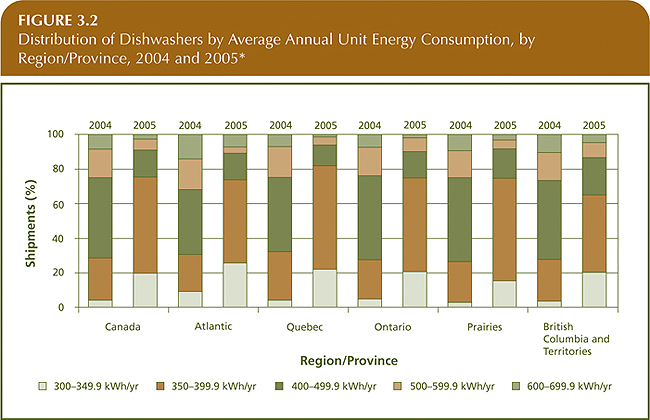
Figure 3.2 shows that there were significant improvements in the average annual UEC of dishwashers throughout the country. In 2004, 28.3 percent of all dishwashers shipped in Canada consumed less than 400 kWh, whereas in 2005, 75.1 percent did. This significant improvement occurred throughout the regions, as demonstrated in Figure 3.2, and is attributed to the new energy-consumption standard and testing procedures mentioned previously.

Click here to view larger image
* For more information, see Table D.19 in Appendix D, "Detailed Tables."
3.2.3 Distribution by Channel, by Region/Province
Figure 3.3 demonstrates the proportion of dishwashers shipped for retail sales versus those shipped for the building trade, in 2004 and 2005. There were only slight changes in the tendencies throughout the country: builder shipments decreased in the Atlantic provinces and increased in British Columbia and the Territories.

Click here to view larger image
* For more information, see Table D.20 in Appendix D, "Detailed Tables."
3.3 Energy Consumption
3.3.1 Average Annual Unit Energy Consumption by Model Year
Between 1990 and 2005, the energy performance of dishwashers improved remarkably. As Figure 3.4 shows, the average annual UEC decreased by about 61 percent, or 630 kWh, during the period. A good part of the improvement occurred before 1995, when the average annual UEC decreased from 1026 to 671 kWh – a decrease of 355 kWh, or 35 percent. After 1995, the decrease in the average annual UEC tapered off substantially. But in 2001, a noticeable decrease began to re-emerge, most likely due to the increase in availability of ENERGY STAR dishwashers and partly due to the announcement of the upcoming 2004 amendment to the MEPS. In 2005, the average annual UEC was 395.7 kWh, a decrease of 275 kWh, or 41 percent, from the 1995 level.

* For more information, see Table D.21 in Appendix D, "Detailed Tables."
3.3.2 Average Annual Unit Energy Consumption by Channel, by Region/Province
Figure 3.5 demonstrates the breakdown of the average annual UEC of dishwashers by shipments for retail purposes and for the builder trade by region/province for 2004 and 2005. It shows that, in 2005, the gap between the average annual UEC for builder and retail shipments narrowed, compared with 2004 figures.

Click here to view larger image
* For more information, see Table D.22 in Appendix D, "Detailed Tables."
3.4 Energy Savings
Figure 3.6 shows how much energy dishwashers might have consumed annually between 1992 and 2005 without the factors previously outlined (top line) and how much energy actually was consumed by refrigerators during those years (bottom line).
The average annual energy savings for dishwashers were estimated to be 0.48 petajoules (PJ) from 1993 to 2005. (No energy savings were expected for 1992.) The largest annual energy savings occurred in 2005, when dishwashers consumed 1.17 PJ less than they might have otherwise.

* For more information, see Table D.23 in Appendix D, "Detailed Tables."
The cumulative energy savings for dishwashers are shown in Figure 3.7. Cumulative energy savings for the study period reached 6.03 PJ in 2005, taking into account the life expectancy factor of dishwashers (this calculation is explained further in Appendix A, "Methodology"). Note that this change to this report's methodology affected only slightly the previous energy savings calculations for 2002 and 2003. The majority of savings occurred post-1999 – between 2000 and 2005 – when energy savings amounted to 3.76 PJ, or 1.04 billion kWh.

Dishwashers Summary
The energy efficiency of dishwashers improved significantly between 1990 and 2005. By 2005, nearly all dishwashers consumed less than 700 kWh annually, with 75.1 percent consuming less than 400 kWh; whereas in 1990, almost all dishwashers (99.8 percent) consumed more than 700 kWh per year.
Of the dishwasher shipments available in 2005, 90.8 percent were ENERGY STAR qualified. A revision to increase the stringency of the ENERGY STAR specification for dishwashers was introduced in January 2007 to address the high percentage of shipments meeting the standard.
About 85.3 percent of all dishwashers were shipped for retail sales, whereas 14.7 percent were tagged for builder shipments. British Columbia and the Territories had a substantially larger share of builder shipments (35.9 percent) than the rest of the country, whereas Quebec had a somewhat lower share (2.9 percent).
The average annual energy savings for dishwashers were estimated to be 0.48 PJ between 1993 and 2005, with total energy savings for that period reaching 6.03 PJ (1.68 billion kWh). Dollar savings for dishwashers for the study period were estimated to be $154 million (calculated at 9.2 cents/kWh).
30 Natural Resources Canada, EnerGuide Appliance Directory 2005 (Ottawa: February 2005), p. 173.