Natural Resources Canada
www.nrcan.gc.ca
Common menu bar links
Office of Energy Efficiency Links
Office of Energy Efficiency
Menu
Energy Consumption of Major Household Appliances Shipped in Canada – Trends for 1990–2005
THE ENERGY STAR® INITIATIVE
The ENERGY STAR symbol is a simple way for consumers to identify products that are among the most energy efficient on the market. Only appliance manufacturers and retailers whose products meet the ENERGY STAR criteria can label their appliances with this symbol. The ENERGY STAR specifications get revised as federally regulated minimum energy performance standards (MEPS) increase in stringency.17
Refrigerators
Standard-size refrigerators must be at least 15 percent more efficient than the MEPS in Canada's Energy Efficiency Regulations to qualify for the ENERGY STAR registered mark.
Qualified compact refrigerators will continue to exceed the MEPS by at least 20 percent.
ENERGY STAR qualified refrigerators typically have a more energy-efficient compressor and better insulation than conventional models. They may also have an "Energy Saver" switch that allows consumers to adjust how much energy the refrigerator uses to keep food fresh.
Freezers
ENERGY STAR qualified standard-size freezers must exceed the MEPS by at least 10 percent. Compact freezer models must exceed the MEPS by at least 20 percent.
Dishwashers
Dishwashers must exceed the MEPS by at least 25 percent to qualify for the ENERGY STAR registered mark. This eligibility criterion became more stringent on January 1, 2007.
Many ENERGY STAR dishwashers use "smart" sensors that adjust the wash cycle and the amount of water used to match the load. They may also have an internal heater to boost the temperature of incoming water.
Clothes Washers
Standard-size clothes washers must be at least 36 percent more efficient than the MEPS and must have a modified energy factor (MEF) of at least 40.21 litres per kilowatt hour per cycle to qualify for the ENERGY STAR registered mark. These eligibility criteria became more stringent on January 1, 2007.
An MEF means that the calculation takes into account the amount of dryer energy used to remove the remaining moisture content. ENERGY STAR qualified clothes washers must have advanced design features that deliver cleaning performance while using less energy and 30 to 50 percent less water. The washer extracts more water from clothes during the spin cycle, thereby reducing the drying time and saving energy and wear and tear on your laundered items.
The ENERGY STAR symbol is becoming increasingly recognized by the Canadian appliance purchaser. The next section analyses trends in ENERGY STAR shipments.
Penetration Rate of ENERGY STAR Qualified Appliances
Figure 2 demonstrates the penetration rate18 of ENERGY STAR qualified appliances since they began appearing on the market in early 1999 (influenced by United States activity spilling into Canada). In 2001, Canada officially adopted the ENERGY STAR registered mark to designate the most energy-efficient appliances. By 2005, 91 percent of all dishwashers, 38 percent of all refrigerators and 46 percent of all clothes washers shipped in Canada were ENERGY STAR qualified products.19
Possible reasons for the higher penetration rate of ENERGY STAR qualified dishwashers – compared with those for clothes washers and refrigerators – are that many of them were made available to the consumer and they were being offered at affordable prices. Dishwasher manufacturers met the specifications quickly, and the incremental cost to meet ENERGY STAR levels was eventually eliminated. Also, the dishwasher specifications had not changed in some time, whereas specifications for refrigerators and clothes washers had. A revision to increase the stringency of the ENERGY STAR specification for dishwashers came into effect in January 2007.
Note that the penetration rate of ENERGY STAR refrigerators decreased from 2003 to 2004 (from 40.7 percent to 34.2 percent) as a result of the more stringent ENERGY STAR level introduced in 2004.
Because the Energy Star Initiative included freezers only recently, they have not been included in the analysis at this time.

Penetration Rate by Region/Province, 2004 and 2005
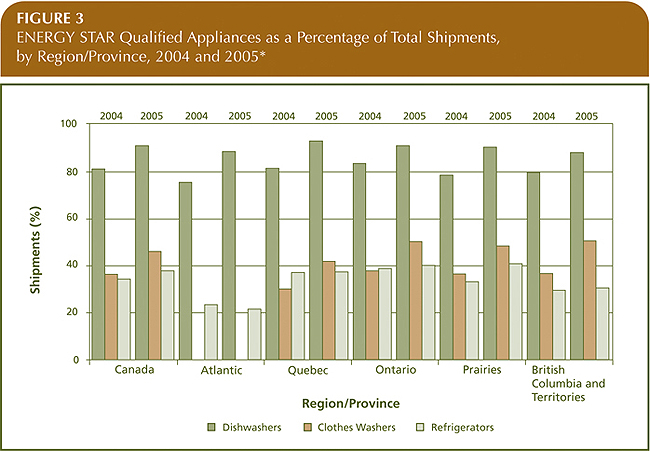
Figure 3 shows the breakdown by region/province for each appliance category covered by the ENERGY STAR Initiative in 2004 and 2005 (excluding freezers). The tendencies remained constant throughout the country, with the penetration rate of all three ENERGY STAR appliances being slightly higher in 2005, with the exception of refrigerators in the Atlantic provinces. Note that, for confidentiality reasons, the rate for clothes washers in the Atlantic provinces is not shown.

Click here to view larger image
17 Natural Resources Canada, EnerGuide Appliance Directory 2005 (Ottawa: February 2005).
18 For each appliance, the penetration rate is the total number of ENERGY STAR qualified appliances shipped divided by the total number of appliances shipped of that particular appliance.
19 These percentages are based on actual figures reported by the Canadian Appliance Manufacturers Association members to the third-party contractor referred to in Appendix A, "Methodology." They differ slightly from those reported in the 2006 Major Appliance Industry Trends & Forecast statistical reference tool published by Electro-Federation Canada. Refer to the section entitled "Reporting Methodology – Expansion Factors" (p. 11) in that publication for more details.