


Natural Resources Canada
www.nrcan.gc.ca
Common menu bar links
Office of Energy Efficiency Links
Office of Energy Efficiency
Menu
Improving Energy Performance in Canada – Report to Parliament Under the Energy Efficiency Act For the Fiscal Year 2006-2007
PDF Version | Table of Contents | Next Page
Introduction
NATURAL RESOURCES CANADA'S EFFICIENCY AND ALTERNATIVE ENERGY PROGRAM
Since the early 1990s, Natural Resources Canada (NRCan) has emphasized the promotion of energy efficiency and the use of alternative energy (that is, alternative transportation fuels and renewable energy) as a means to reduce greenhouse gas (GHG) emissions and improve the Canadian economy.
A complete list of NRCan's efficiency and alternative energy (EAE) initiatives in 2006-2007 is in Appendix 1. These initiatives engage Canadian society and all major sectors of the economy in new and more advanced approaches to secondary energy use-that is, to the consumption of energy in the residential, commercial/institutional, industrial, and transportation sectors.
NRCan's EAE initiatives are managed by
- the Office of Energy Efficiency, which delivers market transformation initiatives to improve energy efficiency and the use of alternative transportation fuels
- the CANMET¹ Energy Technology Centre and the Mineral Technology Branch, which deliver EAE research, development and demonstration (R,D&D) initiatives
- the Electricity Resources Branch, which delivers market transformation initiatives for renewable energy
- the Science Branch of the Canadian Forest Service, which undertakes research and development (R&D) in the use of forest biomass for energy
In its efforts to improve energy efficiency and increase the use of alternative energy, NRCan emphasizes partnership and cooperation with stakeholders such as other levels of government, the private sector and non-governmental organizations. With this approach, the demand side of the energy market moves toward more energy-efficient capital stock, production processes and operating practices without reducing service or comfort levels. On the supply side, Canada participates in developing technology for tapping renewable energy resources and alternative transportation fuels as well as for increasing the energy efficiency of energy production.
POLICY INSTRUMENTS
NRCan's key policy instruments are as follows:
- regulation
- financial incentives
- leadership
- information
- voluntary initiatives
- research, development and demonstration
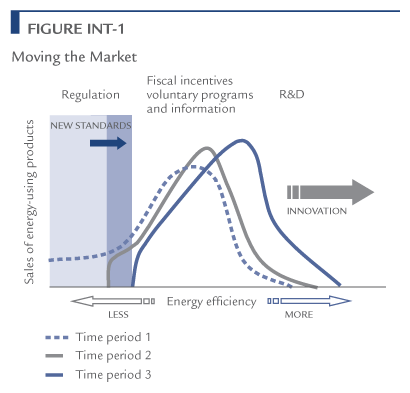
Figure Int-1 shows how these policy tools work together to increase energy efficiency, that is, how they help to reduce the amount of energy needed to obtain a certain level of service. Energy performance regulations eliminate less efficient products from the market. Fiscal incentives, voluntary programs and information increase the take-up of existing opportunities to use energy more efficiently. R&D increases the opportunities for achieving higher levels of efficiency in a particular type of energy use.
Regulation
The Energy Efficiency Act gives the Government of Canada the authority to make and enforce regulations, primarily for establishing performance and labelling requirements for energy-using products and doors and windows that are imported or shipped across provincial borders.
Financial Incentives
NRCan uses financial incentives to encourage final users of energy to employ energy efficiency and renewable energy technologies and practices. NRCan also offers financial incentives for wind energy, ethanol plants, natural gas vehicles and refuelling infrastructure.
Leadership
Leadership means setting an example for other levels of government and for the private sector by increasing energy efficiency and the use of alternative energy in the Government of Canada's operations.
Information
NRCan disseminates information to consumers, using methods that range from broad distribution to individual consultations with clients, to increase awareness of the environmental impact of energy use and to encourage consumers to become more energy efficient and make greater use of alternative energy sources. Activities include publications, exhibits, advertising, toll-free telephone lines, conferences, Web sites, workshops, training, building design software and promotional products.
Voluntary Initiatives
Companies and institutions work with NRCan voluntarily to establish and achieve energy efficiency objectives. NRCan's voluntary EAE initiatives target large consumers of energy in the commercial/institutional and industrial sectors and organizations whose products are important determinants of energy use. The initiatives involve industry-government agreements and, for groups of large industrial energy users, setting energy efficiency targets. NRCan provides support services to assist and stimulate action by companies and institutions on energy efficiency, including developing standards and training.
Research, Development and Demonstration
NRCan's EAE initiatives support the development and dissemination of more energy-efficient equipment, processes and technologies, and alternative energy technologies. R,D&D also provides the scientific knowledge needed to develop the technologies, codes, standards and regulations required for the sustainable use of energy.
NRCan provides national leadership in energy science and technology (S&T) by undertaking research in its own laboratories, contracting research activities to other organizations and carrying out the federal funding initiatives listed in Chapter 9. These initiatives are the only federal interdepartmental S&T investment funds that focus on the energy sector and its economic and environmental effects.
MEASURING PROGRESS
The primary goal of NRCan's EAE initiatives is to change energy consumption patterns to obtain environmental and economic benefits. Part of assessing program progress and performance involves considering both program delivery and program effectiveness.
NRCan monitors and tracks the following three aspects of program delivery:
- program outputs
- program outcomes
- market outcomes
Program outputs are the items produced regularly, such as information and marketing materials, demonstration projects, financial incentives and regulations. Program outputs are designed to lead to program outcomes – namely, changes in the behaviour of groups targeted by a program. These groups may be either energy users or producers of energy-using equipment or structures. For example, program outcomes occur when consumers purchase more energy-efficient appliances than they would have if there were no program. Other important factors that influence consumer behaviour include product price, household income, personal taste and other government and non-government programs.
Since program outcomes can directly affect the amount and type of energy consumed in the market, they contribute, in part, to observable market outcomes. Market outcomes ultimately reflect the impacts of NRCan programs on changes in energy efficiency, energy intensity, GHG emissions and the use of alternative energy. In this sense, achievement of a targeted market outcome, or observable progress towards a market outcome, serves as an indicator of program effectiveness. An example of a program outcome leading to a market outcome is a householder's purchase of a more energy-efficient appliance, resulting in reduced use of electricity. Depending on the source of electricity and how the utility changes its electricity-generating methods to meet the change in demand resulting from reduced electricity use, this could also lead to a decline in GHG emissions.
DATA COLLECTION AND ANALYSIS
In 1991, NRCan launched the National Energy Use Database (NEUD) initiative to help the department improve its knowledge of energy consumption and energy efficiency at the end-use level in Canada and to support NRCan's analytical expertise. The NEUD initiative plays a number of crucial roles directly related to NRCan program activities. However, its most important role is to secure the development of a reliable, Canada-wide information base on energy consumption at the end-use level for all energy-consuming sectors.
The NEUD initiative consists of several broad components that typically involve conducting large- and small-scale surveys of energy use in the transportation, industrial, commercial/institutional and residential sectors. The surveys gather information about the stocks and characteristics of energy-using equipment and buildings, observing Canadians' behaviour with respect to energy use, monitoring the adoption of new technologies in the marketplace. In 2006-2007, the NEUD initiative sponsored the collection of energy data in the commercial, transportation and industrial sectors, analyzed this data and produced reports that explain how and where energy is used in each sector. Work was also initiated to collect energy data in the residential sector in 2007-2008, which will also form the basis for a report. The NEUD initiative also produced a comprehensive energy use database with accompanying publications to explain Canada's overall energy use and energy efficiency trends. All NEUD initiative reports are available to the public, free of charge, both in hard copy and on-line.
The NEUD initiative also has participated in the development of energy end-use data and analysis centres (DACs) across Canada. Three DACs currently exist: the transportation centre at Université Laval in Québec City, Quebec; the industrial centre at Simon Fraser University in Burnaby, British Columbia; and the buildings centre at the University of Alberta in Edmonton, Alberta. The DACs are mandated to improve the accessibility and comparability of existing data about the evolution of energy consumption and its impact on environmental quality.
GHG EMISSIONS AND CLIMATE CHANGE
Climate change is a global challenge arising from the continuing buildup in levels of anthropogenic (human-produced) GHGs in the atmosphere in addition to naturally occurring emissions. GHGs are composed of a number of gases, and the main source of anthropogenic emissions is the combustion of fossil fuels. Substantially reducing GHG emissions is a challenge, particularly given Canada's highly industrialized and resource-based economy. Solutions require a multifaceted, coordinated domestic response and a high level of cooperation among all nations.
IN THIS REPORT
This fourteenth annual Report to Parliament focuses principally on EAE initiatives that address secondary energy use. The EAE programs described in this Report were operational for the 2006-2007 fiscal year. Some of the programs have continued, while others have since been completed. The ecoENERGY programs described within this document were initiated on April 1, 2007 and will continue for the next four years. Trends in energy use and GHG emissions in Canada are discussed in Chapter 1. Chapter 2 discusses the equipment regulations under the Energy Efficiency Act and equipment labelling activities. Chapters 3 to 6 review individual EAE initiatives to improve energy use in housing, buildings, industry and transportation, highlighting their achievements and progress indicators. Chapter 7 deals with renewable energy sources and use. Chapter 8 describes the Government of Canada's actions to improve its own use of energy. Chapter 9 describes general programs that are not specific to the EAE initiatives discussed in Chapters 3 to 7. The final chapter describes domestic and international cooperation in EAE. Appendix 1 contains information about NRCan's EAE expenditures. Appendix 2 contains detailed information about the figure data presented in this report.
ecoENERGY PROGRAMS 2007/2008 – 2010/2011
ecoENERGY for Industry – is designed to improve industrial energy intensity and reduce energy-related industrial GHGs and air pollution. The program is delivered through the long-standing and successful Canadian Industry Program for Energy Conservation (CIPEC), a voluntary partnership between the Government of Canada and industry that brings together industry associations and companies representing more than 98 percent of all industrial energy use in Canada.
ecoENERGY for Biofuels – will invest up to $1.5 billion over 9 years to boost Canada's production of renewable fuels such as ethanol and biodiesel. As a key element of the government's comprehensive strategy on renewable fuels, thsi program will make investment in production facilities more attractive by partially offsetting the risk associated with fluctuating feedstock and fuel prices.
ecoENERGY for Personal Vehicles – offers easy access to information, including fuel consumption guides and other decision-making tools, to help Canadians choose the most fuel-efficient car or truck for their particular needs. This initiative will also work with communities, provincial and territorial governments and other partners to encourage driving and vehicle maintenance habits that increase fuel efficiency, reduce emissions and save money.
To make sure Canadians continue to enjoy a wide selection of fuel-efficient vehicles, the Government is working directly with automakers to reduce GHG emissions by 2010. This voluntary effort by automakers will support mandatory fuel-efficiency regulations that will come into force for the 2011 model year.
ecoENERGY Retrofit – provides financial support to homeowners, small and medium-sized businesses, public institutions and industrial facilities to help them implement energy saving projects that reduce energy-related GHGs and air pollution, thereby contributing to a cleaner environment for all Canadians.
ecoENERGY for Buildings and Houses – is designed to encourage the construction and operation of more energy-efficient buildings and houses using complementary activities such as rating, labelling and training. Energy efficiency makes for healthy workplaces and living spaces, increases comfort and saves money.
ecoENERGY for Fleets – introduces fleets to energy-efficient practices that can reduce fuel consumption and emissions. This program offers free practical advice on how energy-efficient vehicles and business practices can reduce fleet operating costs, improve productivity and increase a fleet's competitiveness.
Along with the latest developments in fleet and fuel management, ecoENERGY for Fleets will also help ensure fleet vehicle owners and managers are aware of the fuel efficiency benefits of new and developing technologies. On the education side of the initiative, it is expected that more than 200 000 professional drivers – of heavy trucks, buses, construction and other vehicles – will receive training in energy-efficient vehicle-operating techniques over the next four years.
ecoENERGY for Renewable Heat – will invest $36 million over four years to increase the use of renewable thermal energy, help develop renewable thermal energy industry capacity and contribute to cleaner air by displacing fossil fuel-based energy use for space heating and cooling and for water heating in Canadian buildings.
Under the program, a solar deployment incentive of 25 percent of project cost targets the industrial, commercial and institutional sectors. Industry capacity development funding is available to support the solar and geoexchance industries in upgrading standards and training installers. And a large-scale residential sector deployment pilot initiative will work with utilities and developers to deploy thousands of solar domestic water-heating systems across Canada.
ecoENERGY for Renewable Power – will invest $1.48 billion to increase Canada's supply of clean electricity from renewable sources such as wind, biomass, low-impact hydro, geothermal, solar photovoltaic and ocean energy.
An incentive of one cent per kilowatt hour to eligible low-impact, renewable electricity projects will encourage the production of 14.3 terrawatt hours of new electricity from renewable energy sources. This represents about 4000 megawatts of new capacity, enough electricity to power approximately 1 million homes.
ecoENERGY Technology Initiative – will fund R,D&D to support the development of the next generation clean-energy technologies to increase the clean energy supply, reduce energy waste and reduce pollution from conventional energy sources. Examples are technologies for clean-coal, carbon sequestration and the reduction of the oil sands' environmental impact; and new end-use technologies, such as hydrogen and fuel cells and energy-efficient buildings and industry. This initiative will also develop technologies for producing and using renewable energy from clean sources such as wind, solar, tidal and biomass.
For more information: ecoaction.gc.ca
¹ CANMET is the Canada Centre for Mineral and Energy Technology.
