


Natural Resources Canada
www.nrcan.gc.ca
Common menu bar links
Office of Energy Efficiency Links
Business: Industrial
Menu
Improving Energy Performance in Canada – Report to Parliament Under the Energy Efficiency Act For the Fiscal Year 2007-2008
PDF Version | Table of Contents | Next Page
Chapter 3: Energy Efficiency and Alternative Transportation Fuels
Natural Resources Canada’s (NRCan’s) Office of Energy Efficiency (OEE) aims to strengthen and expand Canada’s commitment to energy efficiency in all sectors and increase the production and use of alternative transportation fuels in Canada. The OEE is the manager of the ecoENERGY Efficiency Initiative, under the ecoENERGY suite of programs initiated on April 1, 2007. The ecoENERGY Efficiency Initiative includes the following programs:
- ecoENERGY Retrofit
- ecoENERGY for Buildings and Houses
- ecoENERGY for Industry
- ecoENERGY for Personal Vehicles
- ecoENERGY for Fleets
- ecoENERGY for Biofuels
- ecoENERGY for Equipment (see Chapter 2)
In addition to ecoENERGY, the OEE manages the Ethanol Expansion Program and the Federal Buildings Initiative.
This chapter describes the objective of each of the aforementioned programs and outlines key achievements for the 2007–2008 fiscal year.
ecoENERGY Retrofit
Objective
To provide incentives for energy efficiency improvements in homes and in small and medium-sized organizations in the institutional, commercial and industrial sectors. The program is made up of three components:
- ecoENERGY Retrofit – Homes
- ecoENERGY Retrofit – Small and Medium Organizations
- ecoENERGY Retrofit – Existing Buildings Initiative
Targets
Estimates indicate that by 2011, ecoENERGY Retrofit as a whole will result in energy savings between 12.78 and 14.20 petajoules (PJ). At present, these energy savings convert to annual emissions reductions of between 1.0 and 1.1 megatonnes (Mt) of greenhouse gases (GHGs) and related Criteria Air Contaminants (CAC) emissions.
For more information:
ecoaction.gc.ca/retrofit
ecoENERGY Retrofit - Homes
Objective
To assist homeowners and owners of existing low-rise properties make smart energy retrofit decisions that will result in significant energy savings and a cleaner environment.
Description
Property owners can qualify for federal grants by improving the energy efficiency of their homes and reducing their home’s impact on the environment. ecoENERGY Retrofit – Homes offers a professional evaluation by a qualified energy advisor of the energy efficiency characteristics of a house, including a diagnostic test to determine air leakage.
The energy advisor prepares a detailed personalized checklist of recommended upgrades for the property owner, including the EnerGuide pre-retrofit energy rating of the house. The checklist shows the recommended, most effective upgrades. The property owner chooses which upgrades to have done.
After the retrofit work is complete, the advisor performs a post-retrofit energy evaluation and assigns a new energy-rating label. After the required improvements have been made, the property owner is entitled to a grant.
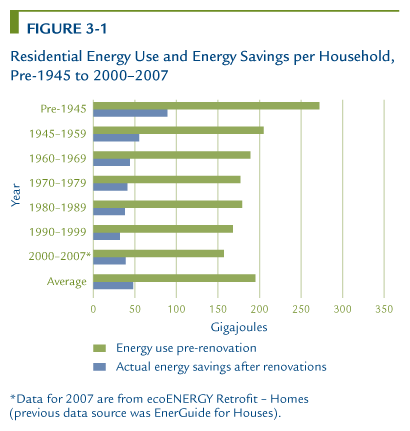
It is expected that the ecoENERGY Retrofit – Homes incentives will promote smart energy use in more than 140 000 homes and will yield an average 30 percent reduction in energy use and costs. Figure 3-1 illustrates the energy use and savings gained per household before and after renovations.
Key 2007-2008 Achievements
- Over 102 000 homeowners have applied for a pre-retrofit assessment.
- Over 12 000 homeowners have completed their retrofits and have received grants.
- Established collaborative agreements with provinces, territories, utilities and other stakeholders, including British Columbia, the City of Edmonton, Saskatchewan, Manitoba, Ontario, Hydro-Québec, the Agence de l’efficacité énergétique du Québec, Gaz Métro, Gazifère, New Brunswick, Nova Scotia, Yukon and the Northwest Territories.
ecoENERGY Retrofit - Small and Medium Organizations
Objective
To encourage Canadian businesses to make their commercial and institutional buildings and industries more energy efficient.
Description
ecoENERGY Retrofit – Small and Medium Organizations provides incentives to businesses to incorporate energy-efficient features in building improvement projects and the upgrading of industrial equipment and processes. Industrial facilities with fewer than 500 employees and commercial and institutional buildings of less than 10 000 square metres may be eligible for funds through contribution agreements with ecoENERGY Retrofit – Small and Medium Organizations.
ecoENERGY Retrofit will provide up to 25 percent of the cost of a project, to a maximum of $50,000. Recipients of funding in this category may also qualify for funding support from utilities and/or other levels of government. To qualify, eligible organizations must submit an application detailing the energy efficiency project, including the total budget, timeframe for completion and expected results, based on a certified technical assessment of the organization’s energy use.
Key 2007-2008 Achievements
- Nine information sessions were held with 435 participants.
- Ninety-six small and medium organizations had their planned retrofit projects approved for assistance.
ecoENERGY Retrofit - Existing Building Initiative
Objective
To encourage commercial businesses and public institutions to become more energy efficient and reduce GHG emissions.
Description
The ecoENERGY Retrofit – Existing Buildings Initiative (EBI) was wound down during the 2007–2008 fiscal year. While active, it helped commercial organizations and public institutions explore energy efficiency options and strategies. The program provided access to tools and financial assistance to help reduce energy costs and improve competitiveness. It enrolled more than 2800 commercial, institutional, and multiunit residential organizations as members and provided over $72 million in federal incentives.
Key 2007-2008 Achievements
- The EBI signed 95 contribution agreements for retrofit projects and 28 contribution agreements for planning activities
- Projects that received financial incentives under the EBI are expected to result in average energy savings of approximately 20 percent.
Federal Buildings Initiative
Objective
To assist Government of Canada organizations in implementing energy efficiency upgrades that lead to reduced energy and water use, GHG emissions and operating costs.
Description
The Federal Buildings Initiative (FBI) is an energy efficiency program targeting federal departments and agencies and Crown corporations. The FBI provides a range of products and services required by an organization in order to implement comprehensive energy efficiency improvement projects in its facilities.
The products include case studies, workshops, technical information, model procurement documents and a qualified list of private-sector energy management firms that can provide energy performance contracting services. FBI services include facilitation such as energy management technical advice, program policy advice and procurement services to assist organizations in making energy efficiency improvements.
Other levels of government, institutions and private sector firms also draw on the FBI’s experience for help in designing their own energy efficiency programs. Through the FBI, thousands of federal buildings have been upgraded, saving millions of dollars and reducing the risks associated with climate change.
Key 2007-2008 Achievements
- The Canadian Forces bases in Gander, Newfoundland and Labrador, and Gagetown, New Brunswick, are proceeding with energy efficiency retrofit projects that are expected to save $5 million in annual energy costs.
- To date, the private sector has made new and incremental investments of $319 million in FBI projects.
- The FBI awarded energy efficiency projects that will reduce the federal government’s annual utility bills by $43 million.
For more information:
oee.nrcan.gc.ca/communities-government/buildings/federal/federal-buildings-initiative.cfm
ecoENERGY For Buildings and Houses
Objective
To encourage the construction and operation of more energy-efficient buildings and houses using complementary activities, such as rating, labelling and training. This four-year program was launched April 1, 2007.
Description
The ecoENERGY for Buildings and Houses program includes the following activities for the buildings sector:
- implementing new design tools and training, such as the Dollars to $ense workshop, so designers, builders, owners and operators can learn about and use best practices and new technologies for energy-efficient buildings
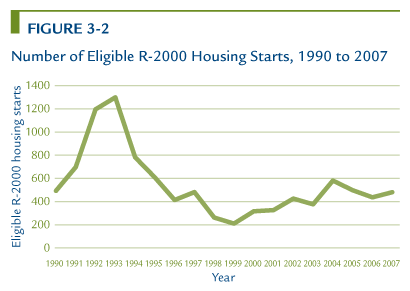
- updating building energy ratings and promoting labelling systems for housing, including the EnerGuide Rating System, R-2000,7 ENERGY STAR® and Built GreenTM, to encourage consumers to invest in energy-efficient options (see Figure 3-2)
- engaging in ongoing dialogue and co-operation with provincial and territorial programs with a view to encouraging other levels of government to adopt more stringent building energy codes
- providing training and implementing outreach and communication strategies to increase awareness and build capacity among building owners, managers and consumers to support the adoption of sustainable energy efficiency programs
- establishing and maintaining partnerships to reduce energy use and improve energy efficiency information
Targets
Estimates indicate that by 2011, this program will result in energy savings of between 17.09 and 18.99 PJ. At present, these energy savings convert to annual emissions reductions of 1.3 and 1.4 Mt of GHGs and related CAC emissions.
Key 2007-2008 Achievements
- Held 207 workshops and trained over 4296 professionals in energy-efficient construction systems for the housing and buildings sectors.
- Issued 108 661 housing labels for new and existing houses.
- Completed a memorandum of understanding (MOU) with the National Research Council to collaborate on the forthcoming update of the Model National Energy Code for Buildings.
For more information:
ecoaction.gc.ca/ecoenergy-ecoenergie/buildingshouses-batimentshabitations-eng.cfm
ecoENERGY For Industry
Objective
To improve industrial energy intensity and reduce energy-related industrial GHGs and air pollution.
Description
The ecoENERGY for Industry program promotes an increase in energy-saving investments across Canada’s industrial sector. The program helps industry become more energy efficient by providing it with tools and services for overcoming the technical, management and financial barriers to project implementation.
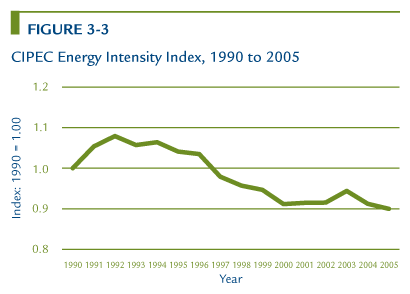
ecoENERGY for Industry is an industry-government partnership delivered through the Canadian Industry Program for Energy Conservation (CIPEC). CIPEC is committed to promoting and encouraging energy efficiency improvements and reductions in GHG emissions through voluntary action across Canada’s industrial subsectors. The estimated CIPEC energy intensity index is shown in Figure 3-3.
Program components include the following:
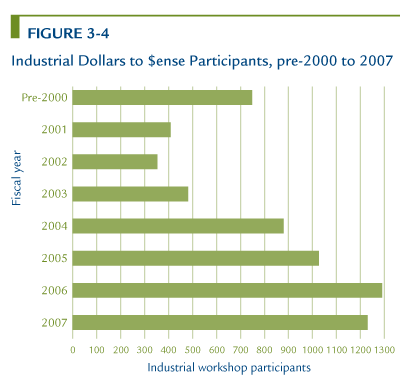
- the Dollars to $ense energy management workshops, which teach industry members how to improve operational efficiency, create a better work environment and reduce GHG emissions (see Figure 3-4)
- the ecoENERGY Assessment Incentive for Industry, which offers a financial incentive to help industrial companies conduct state-of-the-art process integration and computational fluid dynamics studies that identify opportunities for increasing energy efficiency and improving production processes
- the CIPEC Leaders network, which demonstrates the industrial sector’s commitment to reducing energy use, gives members recognition, networking opportunities for best-practice sharing and eligibility for financial incentives
Targets
Estimates indicate that by 2011, this program will result in energy savings of between 4 and 17 PJ. At present, these energy savings convert to annual emissions reductions of between 0.4 and 1.7 Mt of GHGs and related CAC emissions.
Key 2007-2008 Achievements
- Delivered Dollars to $ense energy management workshops for 1290 industrial participants.
- Initiated six studies on process integration, computational fluid dynamics, combustion and energy performance contracting.
- Welcomed 156 new members to the CIPEC Leaders network, which has over 1600 members, and held 59 network meetings.
For more information:
ecoaction.gc.ca/ecoenergy-ecoenergie/industry-industrie-eng.cfm
ecoENERGY For Personal Vehicles
Objective
To encourage and support improvements in energy efficiency by encouraging Canadians to buy, drive and maintain their vehicles with fuel efficiency in mind.
Description
The ecoENERGY for Personal Vehicles program raises awareness of the impact of vehicle choice and use on fuel efficiency and the environment. It does so through the following:
- decision-making information and tools, such as the Fuel Consumption Guide, labels and vehicle awards
- “Eco” driver education and training
- idle-free and tire inflation campaigns
- collaborative ventures with community groups and industry stakeholders
ecoENERGY for Personal Vehicles also facilitates work with the vehicle industry to implement and monitor the voluntary MOU between the Government of Canada and the auto industry to reduce automobile GHG emissions. Program components include the following:
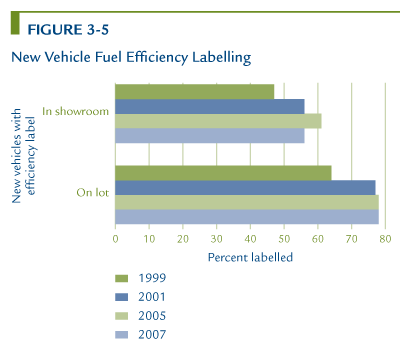
- the EnerGuide labelling system, which places fuel consumption labels on all new light-duty vehicles sold in Canada (see Figure 3-5)
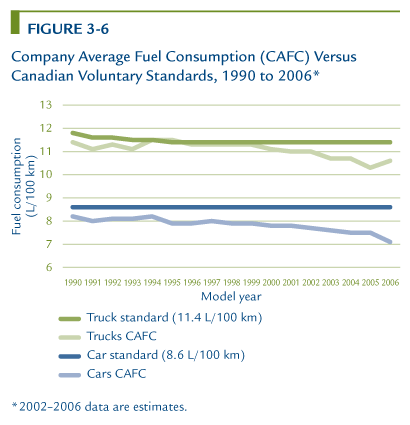
- the 2005 MOU between the Government of Canada and the Canadian auto industry, which provides a framework for auto makers to produce more fuel-efficient and lower-GHG-emission vehicles by 2010 (see Figure 3-6)
- the annual ecoENERGY for Vehicles Awards, which recognize, and identify for consumers, the most fuel-efficient light-duty vehicles in their classes sold in Canada
- the Auto$mart driver education series, which teaches drivers how to drive safely, save money and protect the environment by using fuel-efficient driving techniques
- idle-free and tire maintenance campaigns, which, through the use of educational materials and outreach activities, encourage drivers to embrace fuel-efficient practices
Targets
Estimates indicate that by 2011, this program will result in energy savings of between 50.5 and 75.2 PJ. At present, these energy savings convert to annual emissions reductions of between 4.8 and 5.4 Mt of GHGs and related CAC emissions.
Key 2007-2008 Achievements
- Distributed over 350 00 copies of the Fuel Consumption Guide, including 186 000 to 3386 new car dealerships and 53 000 to Canadian Automobile Association offices.
- Trained 350 000 drivers in fuel-efficient driving practices.
- Reached over 5 million Canadians through exhibits and other marketing activities.
For more information:
vehicles.gc.ca
ecoENERGY For Fleets
Objective
To achieve reductions in fuel use and related costs, air contaminants and GHG emissions through a wide range of measures targeting operators and managers of Canada’s commercial and institutional road vehicle fleets.
Description
The ecoENERGY for Fleets program promotes the adoption of existing and emerging new technologies, such as energy-efficient vehicle components and hybrid technologies, and best practices, such as fuel management techniques, in the commercial/institutional road transportation sector.
ecoENERGY for Fleets is aimed at the commercial/institutional fleet transportation sector and provides information, workshops, technical demonstrations and training programs on fuel-efficient practices for fleet vehicles. Program components include the following:
- the “Idle-Free Quiet Zone” campaign, which uses educational materials and incentives to encourage truck drivers to turn off their vehicles at truck stops
- Fuel Management 101 workshops, which assist fleet managers with the preparation, implementation and monitoring of a fuel management plan
- SmartDriver training programs, which offer knowledge sharing and on-the-road instruction to drivers of various types of fleets for the purpose of reducing fuel consumption
Targets
Estimates indicate that by 2011, this program will result in energy savings of between 6.87 and 10.84 PJ. At present, these energy savings convert to annual emissions reductions of between 0.5 and 0.7 Mt of GHGs and related CAC emissions.
Key 2007-2008 Achievements
- Registered 62 truck stops across Canada under the “Idle-Free Quiet Zone” campaign.
- Developed new bilingual materials for Fuel Management 101 workshops and conducted four workshops.
- Trained 423 school bus drivers under the SmartDriver for School Bus program.
For more information:
fleetsmart.gc.ca
ecoENERGY For Biofuels
Objective
To encourage the development of a competitive domestic industry for the production of renewable alternatives to gasoline and diesel in Canada.
Description
ecoENERGY for Biofuels will invest up to $1.5 billion over nine years to support the production of renewable alternatives to gasoline and diesel in Canada. Announced in 2007, the initiative will make investment in production facilities more attractive by partially offsetting the risks associated with fluctuating feedstock and fuel prices. The program will provide an operating incentive to producers of renewable alternatives to gasoline, such as ethanol, and renewable alternatives to diesel, such as biodiesel, in cases where they have signed a contribution agreement with NRCan and where industry needs support to remain profitable.
ecoENERGY for Biofuels is a key component of Canada’s renewable fuels strategy, which aims to
- reduce the GHG emissions resulting from fuel use
- encourage greater production of biofuels
- accelerate the commercialization of new biofuel technologies
- provide new market opportunities for agricultural producers and rural communities
Key 2007-2008 Achievements
- Program received required approvals.
- Consultations were conducted with biofuels industry stakeholders on program design to ensure program effectiveness.
- Program roll-out was completed, including Web materials, application form and contribution agreement template.
For more information:
ecoaction.gc.ca/biofuels
Ethanol Expansion Program
Objective
To expand fuel ethanol production and use in Canada and reduce transportation GHG emissions.
Description
The Ethanol Expansion Program (EEP) was a $100-million program, co-managed by NRCan and Agriculture and Agri-Food Canada, for which funding ended March 31, 2007. The program provided contributions, with repayment terms, toward the construction costs of new ethanol production facilities or the expansion of existing ones. The intermediate outcomes of the EEP are expanded ethanol production, increased consumer adoption of ethanol and more markets for ethanol fuels in Canada. Nine ethanol plant projects were allocated contributions under the EEP. The longer-term outcome is a reduction in GHG emissions from the transportation sector as ethanol replaces conventional fuels.
Key 2007-2008 Achievements
- Four new ethanol plants started production, adding approximately 313 million litres of ethanol to Canada’s annual ethanol production capacity and bringing the total annual capacity to 871 million litres per year.
- Construction started on two other ethanol plants, which will add another 350 million litres per year in 2008.
- These six plants, which were allocated a total of $63.7 million under the EEP, will reduce GHGs on a full life-cycle basis by an estimated 0.9 Mt a year.
For more information:
vehiclefuels.gc.ca
7 R-2000 is an official mark of Natural Resources Canada.
