


Natural Resources Canada
www.nrcan.gc.ca
Common menu bar links
Office of Energy Efficiency Links
Office of Energy Efficiency
Menu
Canadian Vehicle Survey 2007 Summary Report
Chapter 5. Trip analysis
5.1 Road types used by vehicles
NRCan produces the annual Fuel Consumption Guide,8 which provides Canadians with information on the fuel consumption of new light vehicles. In the Guide, fuel consumption rates are presented for city and highway driving. Fuel efficiency is generally better in the latter case, as highway driving is conducted at constant speeds with little stopping and starting.
Figure 5.1 presents the percentage of distance travelled on highways with a maximum speed limit of 80 kilometres per hour ((km/h)) or more compared with the distance travelled on roads with lower speed limits.
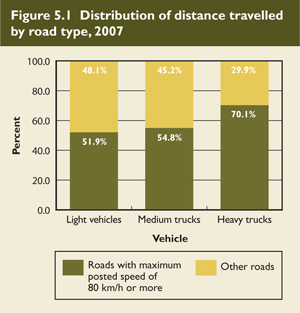
In 2007, light vehicles and medium trucks made less use of roads with a maximum speed limit of 80 (km/h) or more than did heavy trucks. Approximately 55 percent of the vehicle-kilometres travelled by medium trucks was on roads with a maximum speed limit of 80 (km/h) or more, while 70 percent of the distance travelled by heavy trucks was on highways.
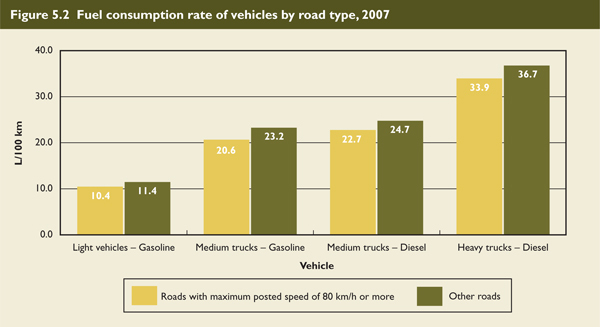
Figure 5.2 shows the fuel efficiency of vehicles by road type. The findings show that fuel consumption per 100 km was indeed affected by road type. The fuel efficiency for each category of vehicle was better on highways (maximum speeds of 80 (km/h) or more), where stops are less frequent.
5.2 Rush hour and fuel consumption
Light vehicles constitute the main means of daily transportation for most Canadians. Table 5.1 shows the distances travelled in 2007 by light vehicles according to place of origin and destination. About 15 percent of the 173 billion km travelled by light vehicles in 2007 was between the driver’s home and work, which occurred most often during rush hour, when traffic is heavy. The traffic jams that are common during rush hour have several impacts on the environment. According to a Transport Canada report on the cost of urban congestion in Canada, between 470 million and 570 million litres of fuel are wasted each year in traffic jams in the largest urban areas. This wasted fuel means an annual output of 1.2 to 1.4 megatonnes of greenhouse gases due to traffic congestion.9
Table 5.1 Vehicle-kilometres travelled by light vehicles in Canada by origin and destination, 2007
| Kilometres (millions) | ||||||
|---|---|---|---|---|---|---|
| End | ||||||
| Start | Home | Work | Personal* | Leisure** | Other | Total |
| Home | 52 961.4 B | 25 437.3 B | 10 005.4 D | 10 238.7 E | 39 747.9 B | 138 390.7 A |
| Work | 22 641.5 B | 7 466.7 D | 2 129.9 E | – F | 6 242.9 E | 39 357.0 B |
| Personal* | 11 457.3 C | – F | 4 344.6 E | – F | 3 554.7 C | 21 832.9 B |
| Leisure** | 10 815.3 D | – F | – F | – F | – F | 23 573.3 C |
| Other | 35 952.5 C | 5 456.8 E | 4 518.0 E | 5 407.6 E | 25 061.7 C | 76 401.3 B |
| Total | 133 827.9 A | 39 573.4 B | 22 334.3 B | 23 942.9 C | 79 867.8 A | 300 203.3 A |
*Personal includes shopping centre, bank and other place of personal business.
**Leisure includes entertainment, recreational facility and restaurant.
The letter to the right of each estimate indicates its quality: A – Excellent, B – Very good, C – Good,
D – Acceptable, E – Use with caution and F – Too unreliable to be published.
Due to rounding, the numbers in the tables may not add up, and some data may differ slightly from one table to the next.
Census data from 2006 show that the median distance travelled by most Canadians when going to work was 7.6 km, while only 14 percent of all workers travelled more than 25 km to get to their regular workplace. The 2007 CVS shows that 60 percent of the distance travelled by Canadians in light vehicles was for trips less than 25 km and was characterized by drivers going to and returning from their regular workplace.10
The data also allow the comparison of the rate of gasoline consumption of light vehicles based on trip length. Figure 5.3 indicates that the fuel efficiency of light vehicles was lower during short-distance trips in 2007. Various factors could contribute to the findings shown in Figure 5.3. For example, given that many of these short trips were not on highways, there would have been more frequent stops and idling, which increase fuel consumption. Furthermore, if a significant percentage of these trips took place during rush hour, there may have been more traffic jams. Finally, if a motor did not reach its optimum operating temperature, it was likely to burn more fuel, as is often the case during very short trips.
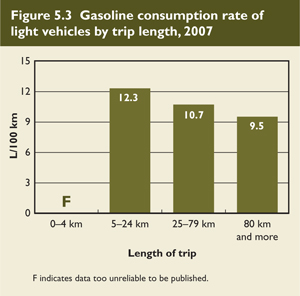
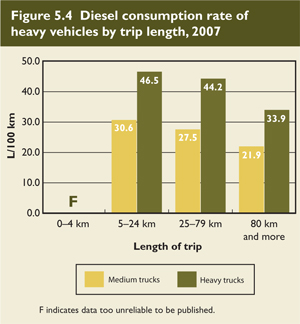
Figure 5.4 shows that the same observations can be made for medium and heavy trucks.
5.3 Driver’s age and gender
The 2007 CVS investigates the relationship between the driver’s age, gender and vehicle use. These variables may affect, for example, the type of car needed to meet work and family requirements.
Table 5.2 shows that in 2007, gasoline-powered vehicles of all categories driven by men travelled twice as many vehicle-kilometres and passenger-kilometres as those driven by women.
Table 5.2 Use of gas-powered vehicles by driver’s gender, 2007
| Men | Women | |
|---|---|---|
| Vehicle-kilometres (millions) | 194 230.7 A | 95 355.9 B |
| Passenger-kilometres (millions) | 320 556.4 A | 151 593.3 B |
The letter to the right of each estimate indicates its quality: A – Excellent, B – Very good, C – Good,
D – Acceptable, E – Use with caution and F – Too unreliable to be published.
Due to rounding, the numbers in the tables may not add up, and some data may differ slightly from one table to the next.
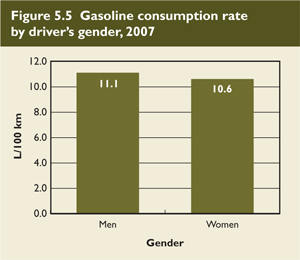
Figure 5.5 shows fuel consumption rates for gas-powered vehicles by gender of driver. In 2007, there was a difference between the fuel efficiency of vehicles driven by men (11.1 L/100 km) and that of vehicles driven by women (10.6 L/100 km).
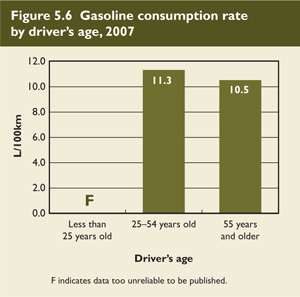
Driver’s age had a limited impact on vehicle fuel efficiency. Figure 5.6 shows that the gas consumption rate of vehicles driven by people between 25 and 54 years old was less than 1 L/100 km more than that of vehicles driven by people 55 years old and over. There was not enough information available to determine the fuel efficiency of vehicles driven by people under the age of 25.
8 oee.nrcan-rncan.gc.ca/transportation/tools/fuel-consumption-guide/fuel-consumption-guide.cfm
9 Transport Canada. The Cost of Urban Congestion in Canada. Ottawa, 2006.
10 www12.statcan.ca/census-recensement/2006/rt-td/pow-ltd-eng.cfm.
