


Natural Resources Canada
www.nrcan.gc.ca
Common menu bar links
Office of Energy Efficiency Links
Business: Industrial
Menu
Improving Energy Performance in Canada – Report to Parliament Under the Energy Efficiency Act For the Fiscal Year 2007-2008
PDF Version | Table of Contents | Next Page
Chapter 5: Renewable Energy
Renewable Energy Use
In 2006, renewable sources accounted for approximately 61 percent of Canadian installed electricity capacity (see Table 5-1). Most of the renewable energy used in Canada comes from either hydroelectricity or thermal energy from biomass, such as wood-waste sources (see Table 5-2).
TABLE 5-1
Electricity Generation Capacity from Renewable Sources
(includes hydroelectricity)
| Year | Renewable electricity generation capacity (megawatts) |
Total capacity (percent) |
|---|---|---|
| 1990 | 59 557 | 58 |
| 1991 | 61 116 | 58 |
| 1992 | 62 895 | 58 |
| 1993 | 63 114 | 56 |
| 1994 | 63 175 | 56 |
| 1995 | 66 542 | 57 |
| 1996 | 67 101 | 59 |
| 1997 | 68 202 | 61 |
| 1998 | 68 340 | 62 |
| 1999 | 68 614 | 62 |
| 2000 | 69 031 | 62 |
| 2001 | 68 845 | 61 |
| 2002 | 71 032 | 62 |
| 2003 | 72 275 | 62 |
| 2004 | 72 947 | 60 |
| 2005 | 74 368 | 61 |
| 2006 | 75 812 | 61 |
Source: Statistics Canada, Electric Power Generating Stations (Cat. No. 57-206-XIB).
TABLE 5-2
Renewable Energy Markets and Technologies Used in Canada
| Electricity | Thermal Energy |
|---|---|
| Hydro-electricity | Biomass (e.g. roundwood, pellets, wood chips) |
| Tidal power | Ground-source heat pumps (e.g. earth energy) |
| Biomass (e.g. wood waste) | Solar air-heating systems |
| Biogas (e.g. methane from landfill sites) | Solar hot water systems |
| Wind | |
| Photovoltaic systems | |
| Mechanical Power | Transportation |
| Wind water pumps | Biodiesel |
| Ethanol from biomass |
Hydroelectricity
Hydroelectricity is a renewable form of electricity generated from a system or technology that uses a mechanical method to capture and convert the potential energy of water.
Hydro is the main source of electricity in Canada, accounting for approximately 60 percent of the electricity generated in 2005. Canada’s hydro supply is dominated by large-scale projects that were developed by electric utilities. Of the 72 661 megawatts (MW) of installed hydro capacity, 3421 MW come from small hydro sites (capacity less than 50 MW), equal to about 2.8 percent of Canada’s total installed electricity capacity. Significant potential remains for additional hydroelectric development in most provinces and territories.
Biomass
Bioenergy is a renewable source of energy derived from the conversion of matter from living organisms or metabolic by-products. Canada has an abundant supply of many types of biomass, which is important for the production of energy, biofuels, materials and chemicals. The two largest sources of biomass supply in Canada are forestry and agricultural operations.
Biomass supply typically takes the following forms:
- forestry – mill or pulp-and-paper residues, black liquor from the pulping process, forest residue, forest management thinnings and short rotation crops
- agriculture – agricultural crops, crop residue, processing residues, algae and aquatic biomass
- other organic waste – animal waste, such as manure from feed lots, municipal solid waste and industrial wastes
Approximately 4.6 percent of Canada’s energy supply comes from bioenergy. This amount of renewable bioenergy ranks second to hydro power (which generates 11.5 percent of Canada’s energy). Most of the bioenergy produced is in the form of industrial process heat, electricity and residential space heating.
The pulp and paper industry is Canada’s major producer and user of bioenergy. Heat and electricity produced by industry, electricity generated by independent power producers, and residential wood heat are considered commonplace in Canada’s energy mix. For example, approximately 3 million Canadian households use wood for home heating. Roundwood is typically used but alternatives include wood chips and pellets. Wood for home heating is usually burned in stand-alone wood stoves, wood furnaces with hot water or forced-air systems, fireplaces with advanced combustion inserts, high-efficiency fireplaces or high-thermal-mass masonry heaters.
Biogas and landfill gas (methane-rich gases that are derived from manure, animal processing wastes, other agricultural residues and municipal waste) for energy production is just emerging. The gases contributed just over 111 MW of power in 2006.
Biomass also shows potential as a feedstock for liquid fuels. Approximately 200 million litres of fuel ethanol are produced annually in Canada from cereal grain and corn. Biodiesel is also produced in small quantities, but production is increasing. Canada has potential to increase its bioenergy production in a sustainable manner.
Earth Energy
As a result of the sun heating the surface of the planet, and because of the insulating qualities of the earth itself, the temperature 1 or 2 metres below the surface remains fairly constant – between 5°C and 10°C. This temperature is warmer than that of the air during the winter and cooler than that of the air in the summer. A ground-source heat pump takes advantage of this temperature difference by using the earth or groundwater as a source of heat in the winter and as a “sink” for heat removed from indoor air in the summer. For this reason, a ground-source heat pump is known as an earth energy system (EES).
During winter, EES installations remove heat from the earth using a liquid, typically an antifreeze solution or water that circulates within an underground loop. The EES then upgrades the heat with a conventional heat pump and transfers it to indoor space or the water-heating system. During summer, the system reverses this process to operate as an air conditioner. EES installations supply less than 1 percent of the market for space and water heating and cooling in Canada.
Wind Energy
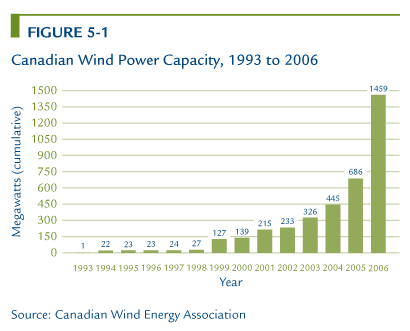
Wind turbines convert the kinetic energy of wind into electrical or mechanical energy. Canada’s land mass and coastal waters combine to provide a wind resource with potential estimated at more than 100 000 MW. As of December 2006, a total of 1459 MW of wind power was installed in Canada. This amount makes Canada the thirteenth country that has reached the 1000-MW milestone and the country with the twelfth-largest installed wind energy capacity. For Canadian wind power, 2006 was a record year, with a 113 percent increase over the 2005 level (1459 MW compared with 686 MW). Recent policy developments have spurred record growth in the Canadian wind generation industry (see Figure 5-1). Wind energy currently accounts for approximately 0.6 percent of Canada’s total electricity generation, up from 0.4 percent in 2005.
Wind energy also provides mechanical power. Several thousand wind-powered water pumps are used throughout Canada, mostly in the Prairie provinces. As well, Canadians use small, residential-sized wind turbines to power cottages and remote houses.
Solar Energy
Three main technologies use energy from the sun:
- passive solar technologies – buildings are designed and located to maximize their reception of solar energy
- active solar thermal systems – solar radiation is converted into thermal energy for heating air or water in residential, commercial and industrial applications
- solar electric (photovoltaic [PV]) systems – solar radiation is used to produce electricity
The Canadian active solar thermal installed capacity in 2005 was 419 000 square metres (m²), or 290 MWthermal. The domestic market increase has averaged 17 percent annually since 1998. In 2005, the solar thermal collector market in Canada was 61 500 m², compared with 53 600 m² in 2004.
The Canadian total PV installed capacity in 2006 was 20.5 MW, with a sustained domestic market growth that has averaged 22 percent annually since 1992. In 2006, the PV module market in Canada was 3.75 MW, compared with 3.68 MW in 2005.
Natural Resources Canada carries out two initiatives to increase the use of small-scale renewable energy in Canada: ecoENERGY for Renewable Power and ecoENERGY for Renewable Heat. They are outlined below.
ecoENERGY For Renewable Power
Objective
To encourage the production of 14.3 terawatt hours (TWh) of electricity from low-impact renewable energy sources (about 4000 MW of new capacity), such as wind, hydro, biomass, solar PV and ocean energy, between April 1, 2007, and March 31, 2011.
Description
The ecoENERGY for Renewable Power program provides an incentive of one cent per kilowatt hour to an eligible low-impact renewable energy project for up to 10 years. Eligible recipients include businesses, institutions/organizations, independent power producers, public and private utilities, and co-operatives that install qualifying renewable power systems. Qualifying projects must have a total rated capacity of 1 MW or greater.
Targets
By 2011, the program will have contributed to the annual generation of 14.3 TWh of electricity or about 4000 MW of capacity, depending on the mix of energy sources supported under the program. At present, these energy savings convert to annual emissions reductions of between 6 and 6.7 megatonnes of GHGs and related Criteria Air Contaminants (CAC) emissions.
Key 2007-2008 Achievements
- Program was launched April 1, 2007.
- 171 projects were registered, representing more than 11 000 MW of capacity.
- 12 contribution agreements were signed with proponents, representing about $305 million in federal funding over 10 years and 948 MW of new renewable power capacity.
For more information:
ecoaction.gc.ca/ecorp
ecoENERGY For Renewable Heat
Objective
To increase the use of renewable energy technologies, develop thermal energy industry capacity and contribute to the reduction of harmful emissions.
Description
The ecoENERGY for Renewable Heat program supports renewable thermal technologies used for space heating and cooling and water heating, through a mix of deployment incentives, residential pilot projects and industry capacity-development funding:
- deployment incentive – providing a financial contribution to encourage the deployment of solar thermal units in the industrial, commercial and institutional sectors
- residential pilot projects – providing financial contributions to test, through collaborative ventures, various approaches to the delivery of solar water-heating projects to encourage the deployment of solar water-heating units in the residential sector
- industry capacity-development – providing financial contributions to develop technology standards, certification procedures for solar thermal technologies, human resources skills and tools for renewable thermal technologies and to provide public information on renewable thermal energy technologies
Targets
It is estimated that, by 2011, this program will result in energy savings of 0.35 petajoules. At present, these energy savings convert to annual emissions reductions of about 20 kilotonnes of GHGs and related CAC emissions.
The emissions reduction expectations are derived from assumptions regarding the displacement of fossil fuel energy used for space heating and water heating in Canada’s building and housing stock, based on current energy consumption profiles. Actual emissions reductions achieved will depend on project parameters, such as the efficiency of the heating equipment in use, the type of fuel displaced, the solar thermal unit output and the thermal loads being applied to the solar units deployed.
Key 2007-2008 Achievements
- Received 369 funding applications from industrial, commercial and institutional sectors to install solar air and solar hot-water systems and signed over 200 contribution agreements with successful applicants, representing about $6 million in federal funding.
- Developed a pilot project that will provide incentives that will result in the installation, by utilities, developers and buyers’ groups, of 8000 solar water-heating systems in Canadian homes over the three remaining years of the program. It will also set the stage for the transformation of the Canadian water-heating market.
- Established a partnership with two provincial governments and renewable energy industry associations.
For more information:
ecoaction.gc.ca/heat
