


Natural Resources Canada
www.nrcan.gc.ca
Common menu bar links
Office of Energy Efficiency Links
Office of Energy Efficiency
Menu
Energy Consumption of Major Household Appliances Shipped in Canada, Summary Report –
Trends for 1990–2009
PDF Version | Table of Contents | Next Page
Chapter 1: Refrigerators
1.1 Average annual unit energy consumption by model year
A refrigerator shipped in 2009 consumed (on average) significantly less energy than one shipped in 1990; the average annual unit energy consumption (UEC) decreased by more than half during this period, from 956 to 430 kilowatt hours per year (kWh/yr). The largest decrease occurred in the 18.5 to 20.4 cubic foot (cu. ft.) category, which saw a 60 percent decrease in energy consumption from 1133 to 456 kWh/yr.
1.2 Distribution of shipments by type
Refrigerators are manufactured in a range of sizes and with a variety of features, all of which affect energy consumption. Consequently, EnerGuide groups refrigerators according to both type and size, enabling the comparison of energy consumption among similar models.
Refrigerators are categorized as standard (full-size) with and without automatic defrost (with and without through-the-door ice service), and compact models.7 The standard-size refrigerator types with the greatest market share in 2009 were Type 3 (49 percent), Type 5 (24 percent) and Type 7 (7 percent). Substantial supplementary data received from compact refrigerator manufacturers in 2009 show a 17 percent market share for compact models in that year (see Table A.4 in Appendix A). Table A.8 summarizes regional shipment data by type.
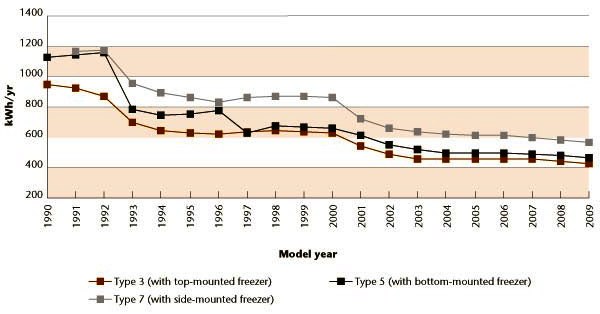
The popularity of different refrigerator types has implications for energy consumption. Figure 1 shows the average annual UEC for Type 3, Type 5 and Type 7 (standard-size) refrigerators. The energy consumption of all three types has decreased over time. In 2009, Type 3, 5 and 7 refrigerators consumed (on average) 424, 463 and 563 kWh/yr, respectively. Table A.7 in Appendix A summarizes the average annual UEC for all standard-size and compact refrigerator types over the study period.
Figure 1 Average annual UEC of standard-size refrigerators by type, 1990–2009
1.3 Distribution of shipments by unit energy consumption per volume
While the average annual UEC of refrigerators shipped between 1990 and 2009 decreased, the energy consumption per unit of volume decreased even more because of the higher efficiency gains of larger refrigerators.
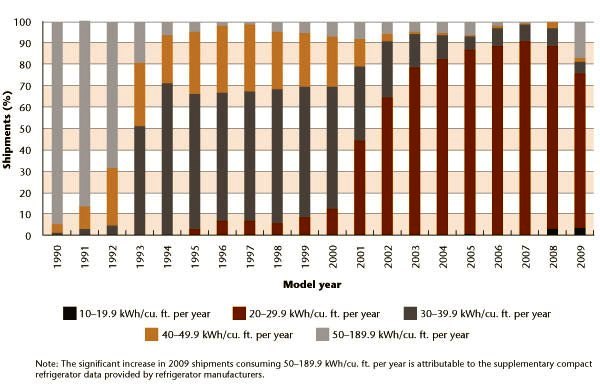
Figure 2 shows the distribution of shipped refrigerators by their average annual UEC per cubic foot from 1990 to 2009. Almost two decades ago, the vast majority of shipped refrigerators (around 95 percent) consumed more than 50 kWh/cu. ft. per year, whereas in 2009, 76 percent consumed less than 30 kWh/cu. ft. per year. This percentage is a decrease from the previous year (89 percent) due to the supplementary compact refrigerator data obtained in 2009.8 Also in 2009, refrigerators of the lowest energy range (less than 20 kWh/cu. ft. per year) achieved a market penetration of 3.5 percent (up from 3 percent in the previous year).
Figure 2 Distribution of refrigerators by average annual UEC per cubic foot, 1990–2009
A series of tables in Appendix A outline regional refrigerator shipment data by type, average annual UEC, channel (builder vs. retail) and volume.
6 The definitions of the various types of refrigerators can be found in Appendix B.
7 Compact refrigerators are those with a volume of less than 219.5 litres (7.75 cu. ft.) and a height of less than 91.4 centimetres (36 inches).
8 Although compact refrigerators consume considerably more energy per unit of volume, overall they consume the smallest amount of energy of all refrigerators (see Tables A.14 and A.15 in Appendix A).
